

The mystery of solar rain, also known as coronal rain, has largely been solved by recent research, particularly concerning its rapid formation during solar flares.
Solar rain isn’t water, but rather dense clumps of plasma that condense high up in the Sun’s atmosphere (the corona) and then fall back toward the solar surface, tracing the Sun’s powerful magnetic field lines.
What is Solar Rain?
Solar rain is a phenomenon that occurs in the Sun’s corona, the outermost layer of its atmosphere, where temperatures typically soar to over a million degrees Celsius.
• Formation: It begins when superheated plasma in the corona, often channeled along magnetic loops above a solar flare, cools dramatically. This rapid cooling leads to a thermal instability, causing the plasma to condense into relatively cooler, denser blobs or threads.
• The “Rain”: Gravity then pulls these condensed clumps back down toward the Sun’s surface (photosphere) along the magnetic field lines, creating the visual effect of rain.
The Solved Mystery: Rapid Formation
The central mystery for decades was how this rain could form so quickly—often within minutes of a solar flare—when traditional solar models predicted that the necessary cooling and condensation process should take hours or even days.
The solution, recently proposed by researchers, involves the dynamic nature of the Sun’s chemical composition:
1. Challenging Assumptions: Previous models assumed that the distribution of various chemical elements in the corona remained constant over time and space.
2. The Key Insight: Researchers found that when elements like iron (which have a low first ionization potential) are allowed to change dynamically over time and location, they dramatically affect the plasma’s ability to radiate heat (cool).
3. Runaway Cooling: This dynamic change in elemental abundances (a shift in the relative amounts of elements) creates a localized spike in radiative cooling, which triggers a runaway condensation process that allows the dense, cool plasma blobs to form on the rapid timescales actually observed during a solar flare.
This discovery is a major breakthrough, as it suggests that fundamental assumptions about how energy is heated and circulated in the Sun’s outer layers may need to be revisited.
The corona of the sun
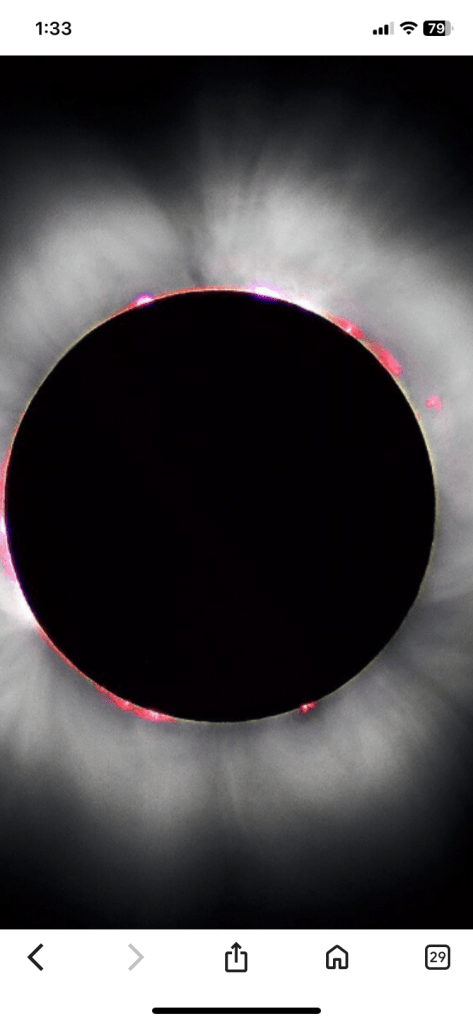
The corona of the Sun is an extraordinary place, with temperatures exceeding one million degrees Celsius, far hotter than the Sun’s visible surface below. During solar flares, violent releases of magnetic energy, plasma can cool dramatically and condense into dense blobs that plummet back toward the Sun’s photosphere, its visible surface. These falling streams of cooler material create the phenomenon of coronal rain. However, existing solar models couldn’t explain the speed at which this cooling happens.
Traditional solar models assumed that the distribution of specific elements throughout the corona remains constant across both space and time. This simplification made calculations manageable but created a significant problem when scientists tried to match their models with actual observations. Earlier theories required heating over hours or even days to produce the conditions necessary for coronal rain, yet solar flares unfold in mere minutes. Something fundamental was clearly missing from the picture.
Luke Benavitz, a graduate student, and astronomer Jeffrey Reep discovered the missing piece. Their research, demonstrates that allowing elemental abundances to vary with time produces models that finally match real solar observations. Elements like iron don’t remain uniformly distributed in the corona but shift dynamically as conditions change. When this variation is plugged into the models, coronal rain can form on the timescales actually observed during solar flares.
What is the composition of earth rain

Solar rain and Earth rain are fundamentally different phenomena, despite both involving a form of condensation and precipitation
Solar rain and Earth rain are fundamentally different phenomena, despite both involving a form of condensation and precipitation
.
The primary composition of Earth rain is liquid water (\text{H}_2\text{O}), but it is a slightly acidic, dilute solution that contains dissolved atmospheric gases, salts, and various ions.
Rainwater can be broken down into three main components:
1. Liquid Water (\text{H}_2\text{O})
• This is the main constituent, formed through the process of condensation where water vapor cools and turns back into liquid droplets.
• The water molecules condense onto tiny solid particles in the atmosphere called condensation nuclei (e.g., dust, pollen, smoke, or sea salt).
2. Natural Acidic Components (Unpolluted Rain)
Even in unpolluted air, rain is naturally slightly acidic due to the dissolution of atmospheric carbon dioxide:
• **Carbon Dioxide (\text{CO}_2): When \text{CO}_2 dissolves in rainwater, it forms a weak acid called carbonic acid (\text{H}_2\text{CO}_3).
• \text{H}_2\text{O} + \text{CO}_2 \rightleftharpoons \text{H}_2\text{CO}_3
• pH Level: This natural acidity gives clean or unpolluted rainwater a \text{pH} value of approximately 5.6 (pure water is neutral at \text{pH} 7).
3. Dissolved Ions and Impurities (Natural & Anthropogenic)
As the water droplets fall through the atmosphere, they wash out and dissolve various solid and gaseous substances, determining the rain’s final chemical profile. The specific mixture varies greatly by location:
What is the composition of solar rain
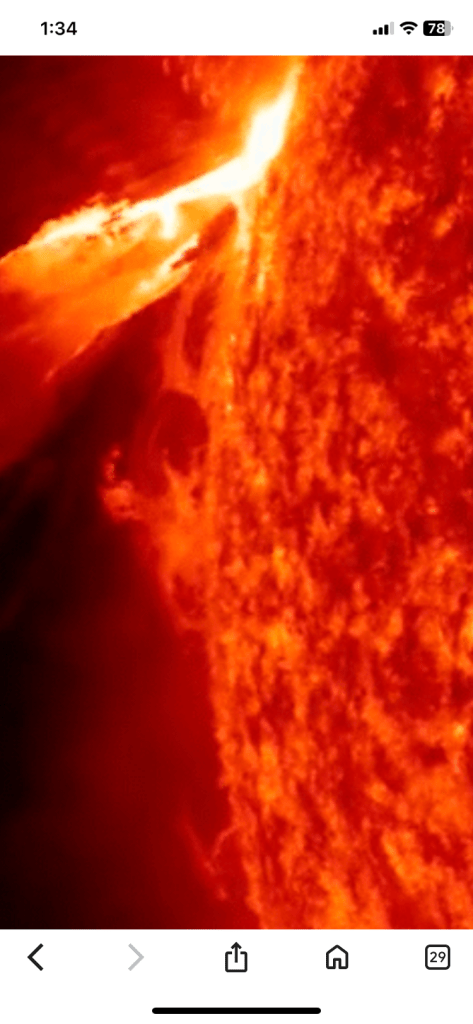
The composition of solar rain, or coronal rain, is fundamentally plasma. It is not made of water.
The material that falls in a solar rain event is characterized by its state, density, and temperature relative to its surroundings:
• State of Matter: Solar rain consists of plasma, which is an extremely hot, ionized gas. This means the atoms have been stripped of their electrons, creating a mixture of ions and electrons.
• Primary Elements: Since the Sun is overwhelmingly composed of these elements, the plasma is primarily made of hydrogen and helium.
• The “Clumps”: The “raindrops” are actually dense clumps or threads of this plasma that condense out of the much hotter surrounding atmosphere.
• Temperature: While the surrounding solar corona can reach over 1 million degrees Celsius (\text{M} \text{K}), the condensed plasma in the rain is much “cooler,” typically around \mathbf{50,000 \text{ to } 100,000} degrees Celsius (\mathbf{50 \text{ to } 100} \text{ kK}).
• Density: The clumps that form the rain are roughly \mathbf{100 \text{ times denser}} than the super-hot, tenuous plasma in the rest of the corona, which is what allows them to fall under the Sun’s gravity.
• Role of Heavy Elements: Recent research has found that the dynamic changes in the distribution of low first ionization potential (FIP) elements, such as iron, magnesium, and silicon, play a crucial role. These elements, when concentrated, can dramatically increase the plasma’s cooling rate, triggering the rapid condensation.
Please like subscribe comment your precious comment on universe discoveries
Full article source google
Please like subscribe comment your precious comment on universe discoveries
Full article source google
 Universe discoveries
🙏🌹
Aum Shanti
LikeLike