
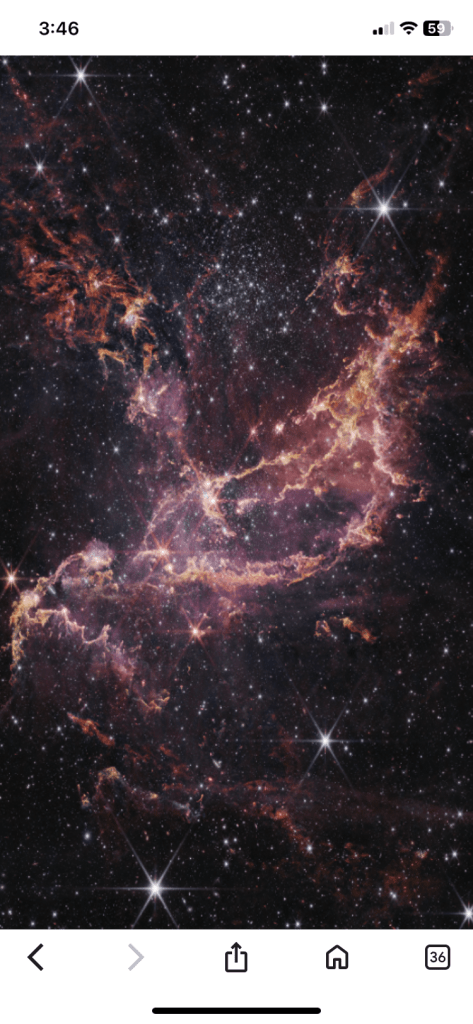
The James Webb Space Telescope (JWST) has unexpectedly detected complex organic molecules (COMs), often referred to as the “building blocks of life,” in frozen ice around a young star in the Large Magellanic Cloud (LMC), a neighboring galaxy to the Milky Way.
Key Discovery Details
• Location: The discovery was made around a young star named ST6 in the Large Magellanic Cloud (LMC). This marks the first confirmed detection of several of these complex organic molecules in ice outside the Milky Way galaxy.
• The Molecules: Using its Mid-Infrared Instrument (MIRI), JWST identified a set of carbon-based compounds in the frozen ice, including:
• Ethanol (a type of alcohol)
• Methyl formate
• Acetaldehyde
• Methanol
• Acetic acid (the main component of vinegar), which had never been conclusively seen in space ice before.
• Significance: The LMC is known to have fewer heavy elements than the Milky Way and is exposed to intense ultraviolet (UV) radiation, making it a much harsher environment. The discovery proves that these complex organic molecules can form and survive under a greater variety of extreme interstellar conditions, including those that resemble the conditions of the early Universe. This suggests that the chemical ingredients for life may be much more widespread throughout the cosmos and may have formed much earlier than previously thought.
• Implication for Life: While the findings do not confirm the existence of extraterrestrial life, they show that the “seeds of life” can form and endure, implying that they could survive the formation of planetary systems and potentially seed early planets, making life a possibility in a broader range of galactic environments.
This news story is related to the ongoing search for life beyond Earth, including an exploration of the exoplanet K2-18 b.
James Webb Space Telescope Finds New Planets! Could They Harbor Life?
No bio signatures no alien 👽 life but ?

Not biosignatures. Not aliens. But the kind of molecules that, on Earth, helped the first chemistry get going.
The lights in the control room were dim enough that the screens felt like windows. On one of them, a thin orange line crawled across the black—a mid-infrared spectrum from a galaxy so distant it arrived redshifted and tired. A small bump rose where nothing was supposed to be. Then another. A postdoc leaned forward, not blinking, as the software traced the peaks and whispered labels we all knew from lab textbooks: carbon rings, simple nitriles, a faint hint of something amide-like. It felt like hearing a familiar song on a station you never tune to.
A life-leaning fingerprint from a galaxy that shouldn’t have it yet
What JWST saw is a set of mid-infrared features consistent with carbon-rich molecules—some of them considered prebiotic precursors—coming from a star-forming galaxy more than 10 billion light-years away. The signals aren’t bright fireworks. They’re modest rises and dips, stacked where aromatic rings and simple organics tend to leave their marks. **It’s the kind of chemistry that makes biologists sit up and astronomers double-check their baselines.**
Building blocks of life” is a loaded phrase, so here’s the plain version: you need carbon frameworks, reactive nitrogen, and oxygen-bearing groups to stitch prebiotic chemistry. The spectrum here shows evidence for carbon rings (think PAH-like), hints of hydrogen cyanide relatives, and possible formamide-like absorption in the mix. Not life. Not even cells. Just the scaffolding that can lead there under the right heat and time. *If life’s chemistry can start this far out and this early, our cosmic neighborhood just got busier.*
Please like subscribe comment your precious comment on universe discoveries
Full article source google
 Universe discoveries
🙏🌹
Aum Shanti
LikeLiked by 1 person