

🌊 Massive Water Reservoir Deep Within Earth
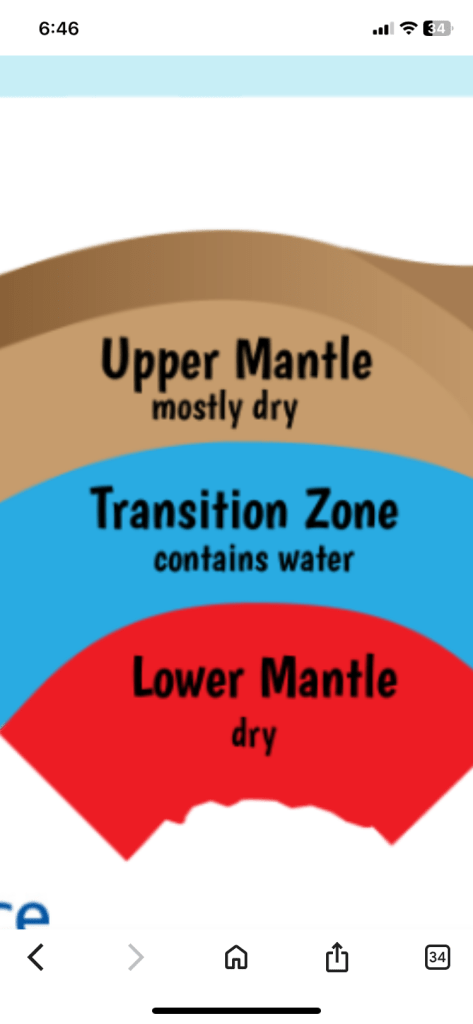
Scientists have indeed found evidence of a gigantic reservoir of water hidden hundreds of miles beneath the Earth’s surface, specifically in the transition zone between the upper and lower mantle (roughly 410 to 660 kilometers deep).
Key Facts About the Discovery:
• Not a Liquid Ocean: This is not an ocean of liquid water, but rather water trapped inside the molecular structure of high-pressure mantle minerals, primarily ringwoodite. The mineral acts like a giant, dense sponge, holding the components of water (hydroxyl ions) under immense pressure and temperature.
• Mineral: The mineral responsible for holding this water is ringwoodite, a form of olivine that is stable under the extreme conditions of the mantle transition zone.
• Volume: Estimates suggest this underground reservoir could hold an amount of water equivalent to one to three times the volume of all the Earth’s surface oceans combined.
• Method of Discovery: The presence of this water was inferred by analyzing seismic waves generated by earthquakes. Researchers observed that the waves slowed down as they passed through the ringwoodite-rich region, a characteristic suggesting the presence of water-bearing rock. The finding was later confirmed by analyzing a natural sample of ringwoodite found as an inclusion in a diamond that surfaced from the mantle.
• Significance: This discovery challenges previous theories about the origin of Earth’s water (some believe it arrived solely via comets) and is critical to understanding the planet’s deep water cycle, plate tectonics, and volcanism.
The concept of a hidden ocean inside the Earth is explored in this video, Huge Underground Ocean Discovered Deep Beneath Earth. This video discusses the discovery of the massive water reservoir locked inside minerals in the Earth’s mantle.
Scientists have found compelling evidence of a vast, hidden water reservoir deep within the Earth’s mantle, about 400 miles (700 km) beneath the surface. This “ocean” is not liquid water but is trapped within a mineral called ringwoodite, which holds water molecules in a unique state between solid, liquid, and gas under immense heat and pressure. The reservoir is estimated to hold up to three times more water than all of Earth’s surface oceans combined.
The presence of liquid water on the surface is what makes our “blue planet” habitable, and scientists have long been trying to figure out just how much water may be cycling between Earth’s surface and interior reservoirs through plate tectonics.
Geological processes on the Earth’s surface, such as earthquakes or erupting volcanoes, are an expression of what is going on inside the Earth, out of our sight,” said Jacobsen, a co-author of the paper. “I think we are finally seeing evidence for a whole-Earth water cycle, which may help explain the vast amount of liquid water on the surface of our habitable planet. Scientists have been looking for this missing deep water for decades.”
The ringwoodite is like a sponge, soaking up water,” Jacobsen said. “There is something very special about the crystal structure of ringwoodite that allows it to attract hydrogen and trap water. This mineral can contain a lot of water under conditions of the deep mantle.”
Did ringwoodite challenges the theory that all water on earth comes from comets
Yes, the discovery of water locked in ringwoodite significantly challenges and complicates the theory that all of Earth’s water came solely from comets or icy asteroids.
How Ringwoodite Challenges the External Source Theory
The presence of a massive, deep-Earth water reservoir provides strong evidence for an internal or primordial origin for much of Earth’s water, suggesting it was built into the planet from the beginning.
1. Supports Primordial Water Hypothesis: The deep water suggests that hydrogen and oxygen, the components of water, were incorporated into the planet’s rocky material as it formed billions of years ago. The minerals like ringwoodite then locked this water inside the mantle.
2. An Alternative Source: If the mantle holds the equivalent of up to three surface oceans, it means that a large fraction of Earth’s water was not delivered from space later, but instead resided within the planet from its formation. This water could have slowly “sweated out” to the surface over geologic time, contributing to the oceans we see today.
The current scientific consensus is moving toward a dual-source model, where the Earth’s water is a mix of both primordial water released from the mantle (supported by ringwoodite) and water delivered by comets and asteroids (the external source theory). The ringwoodite finding simply shifts the perceived balance, confirming the deep, internal source as a major player.
Please like subscribe comment your precious comment on universe discoveries
Full article source google
 Universe discoveries
What an absolutely fascinating and well-presented piece! 🌍💧
You’ve captured one of the most astonishing geological discoveries of our time with clarity, depth, and scientific precision. The way you’ve explained the concept — that this is not an ocean of liquid water, but water locked within the crystal structure of ringwoodite — makes a highly complex topic accessible and deeply engaging.
Your writing beautifully highlights the significance of this finding — how it reshapes our understanding of Earth’s deep water cycle, plate tectonics, and even the origin of our planet’s oceans. The connection you’ve drawn between seismic evidence, mineralogy, and planetary science shows thoughtful insight.
LikeLiked by 1 person
Thanks sir
LikeLiked by 1 person
🙏🌹
Aum Shanti
LikeLiked by 1 person