
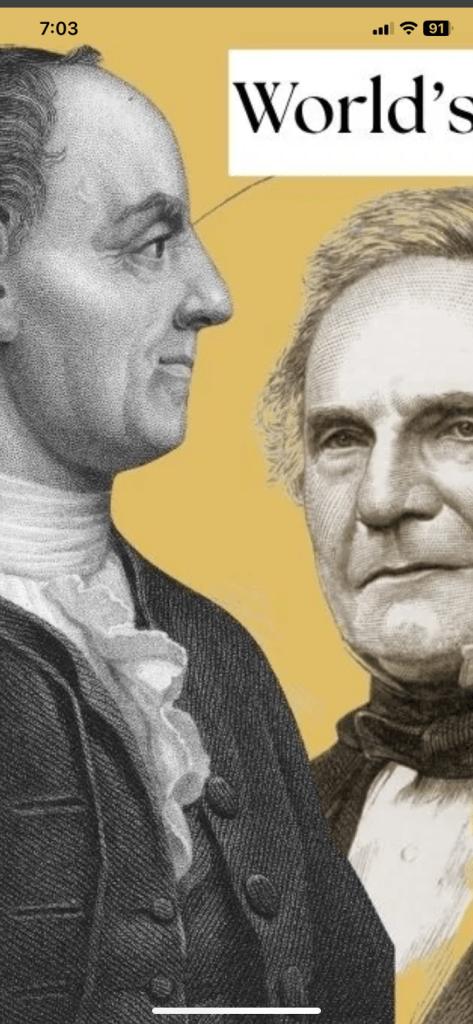
Here are nine of the most famous and influential mathematicians in history, whose discoveries laid the foundation for much of modern science and technology:
9 Famous Mathematicians and Their Legacy 🔢
• 1. Archimedes (c. 287–212 BC)
• Contributions: Regarded as the greatest mathematician of antiquity. Made monumental advances in geometry (calculated \pi (pi) precisely, volumes, and areas), physics (principle of buoyancy/Archimedes’ Principle, law of the lever), and laid groundwork for calculus with the method of exhaustion.
• 2. Euclid (c. 300 BC)
• Contributions: Known as the “Father of Geometry.” His work, Elements, is one of the most influential textbooks ever written, systematically compiling and proving geometry based on a set of axioms and postulates. It defined the study of geometry for over two millennia.
• 3. Pythagoras (c. 570–495 BC)
• Contributions: Best known for the Pythagorean theorem (a^2 + b^2 = c^2). He was a philosopher who believed that “numbers rule the universe” and made profound connections between mathematics, music (harmony and proportions), and philosophy.
• 4. Aryabhata (c. 476–550 AD)
• Contributions: An early pioneer of Indian mathematics. His work was crucial to the development of the decimal number system and the concept of zero (as both a digit and a value). He also contributed to trigonometry (sine tables) and astronomy.
• 5. Muhammad ibn Musa al-Khwarizmi (c. 780–850 AD)
• Contributions: Formally established algebra as a field of study (the word “algebra” comes from the title of his book, Al-Jabr). The term “algorithm” is a Latinization of his name. His work was pivotal in transmitting the Hindu-Arabic numeral system to the West.
• 6. René Descartes (1596–1650)
• Contributions: Developed Analytical Geometry (Cartesian Coordinate System or x-y plane), which unified algebra and geometry. This breakthrough allowed geometric problems to be solved using algebraic equations and vice versa, which was foundational for the later development of calculus.
• 7. Isaac Newton (1643–1727)
• Contributions: Co-inventor of Calculus (fluxions), a revolutionary mathematical tool for modeling change. Also formulated the Laws of Motion and Universal Gravitation, which relied heavily on his mathematical framework, establishing modern physics.
• 8. Leonhard Euler (1707–1783)
• Contributions: Considered the most prolific mathematician ever. He popularized modern mathematical notation, including e (the base of the natural logarithm), i (the imaginary unit), and the function notation f(x). He made vast contributions to calculus, graph theory, and number theory. His formula, e^{i\pi} + 1 = 0, is often called the most beautiful equation in mathematics.
• 9. Carl Friedrich Gauss (1777–1855)
• Contributions: Known as the “Prince of Mathematicians.” He made profound contributions across almost every field of mathematics, including number theory, statistics (method of least squares), analysis, and geometry. His work brought unprecedented rigor and depth to the field.
From ancient Greece to modern India, these mathematicians transformed the way we think about numbers, patterns, and the universe itself. The table below shows the discoveries of mathematicians, from engineering and architecture to algorithms and artificial intelligence
Conclusion
Mathematics is one of the greastest discovories ever made and through the lens of these seven legends, it is more than just about alculation. It’s the language of reason and imagination that continues to shape humanity’s progress.
Please like subscribe comment your precious thoughts on universe discoveries
Full article source google
 Universe discoveries
🙏🌹
Aum Shanti
LikeLiked by 1 person