
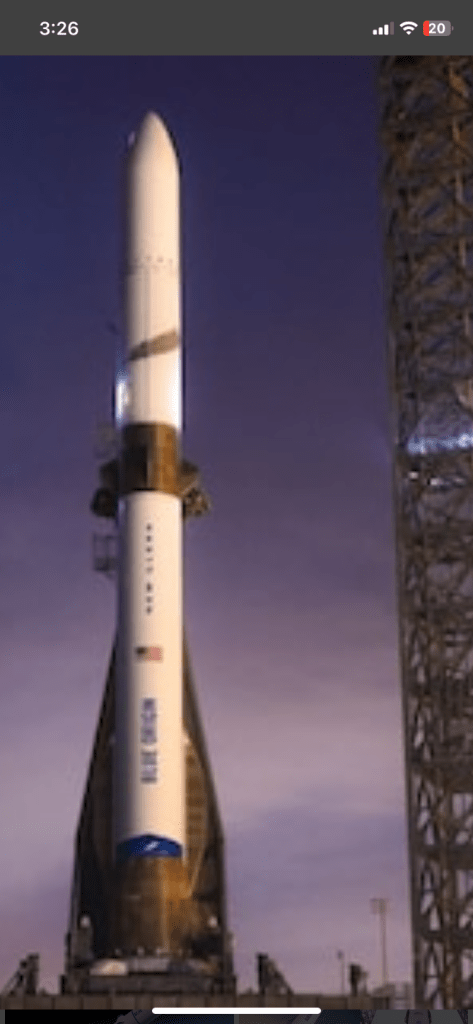
! Blue Origin’s New Glenn rocket successfully launched and completed its second mission on Thursday, November 13, 2025.
Key Highlights of the Mission:
• Mission Success: The rocket successfully deployed its main payload, which was NASA’s ESCAPADE twin spacecraft, on a path toward Mars to study the planet’s magnetosphere.
• Booster Landing Milestone: Crucially, the reusable first stage of the New Glenn rocket successfully landed on Blue Origin’s drone ship, the Jacklyn, in the Atlantic Ocean. This was the rocket’s second flight and the first time New Glenn’s first stage has been successfully recovered. This achievement makes Blue Origin only the second company, after SpaceX, to master the complex technology of landing an orbital-class rocket booster for reuse.
The successful launch and landing mark a significant step forward for Blue Origin in the commercial space launch market.
The escapade mission
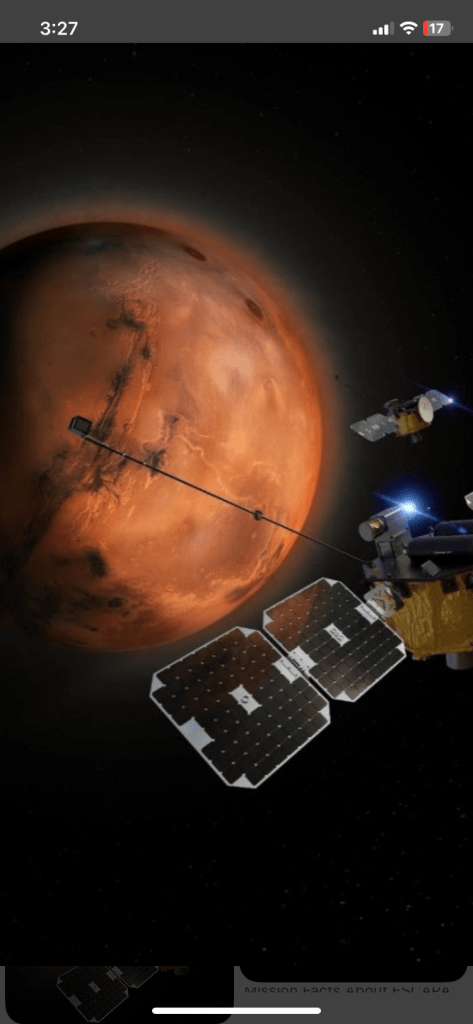
The ESCAPADE (Escape and Plasma Acceleration and Dynamics Explorers) mission is a pioneering, low-cost NASA mission to Mars, utilizing two identical small satellites to achieve its goals.
Here are the key details about the mission:
🔬 Mission Primary Goal
The main objective of ESCAPADE is to study Mars’ unique “hybrid” magnetosphere and understand how the solar wind has stripped away the planet’s atmosphere over billions of years. This process is believed to be the reason Mars transformed from a warmer, wetter world to the cold, dry planet we see today.
🛰️ Key Features
• Twin Spacecraft: The mission uses two identical satellites, nicknamed Blue and Gold (after the University of California, Berkeley’s colors, who leads the mission).
• Simultaneous Observations: By flying in different orbits simultaneously, the twin spacecraft can take stereo measurements of the Martian environment. This allows scientists to distinguish between changes caused by time (e.g., a solar flare event) and changes caused by location (e.g., different regions of Mars’ magnetosphere).
• Low-Cost Approach: ESCAPADE is part of NASA’s SIMPLEx (Small Innovative Missions for Planetary Exploration) program, designed to demonstrate high-value science on a fraction of the cost of typical planetary missions.
📐 The Unique Trajectory
The mission uses a novel flight plan to reach Mars, made necessary because the launch on the New Glenn rocket did not align with a prime Mars launch window:
1. Launch & Loiter: After the November 2025 launch, the twin probes will first travel to the Earth-Sun Lagrange Point 2 (L2), where they will “loiter” for about 12 months while studying space weather.
2. Gravity Assist: In late 2026, they will leave the L2 point and swing back toward Earth for a gravity assist maneuver, which will give them the necessary speed boost for the journey to Mars.
3. Arrival: ESCAPADE is currently projected to arrive in Mars orbit in September 2027.
🔭 Scientific Focus Areas
The ESCAPADE satellites will collect data to:
• Measure Atmospheric Escape: Quantify how quickly ions (charged particles) from Mars’ upper atmosphere are being lost to space.
• Map the Hybrid Magnetosphere: Study the structure of Mars’ magnetic environment, which is patchy (a “hybrid” magnetosphere) due to regions of magnetized crust rather than a global magnetic field like Earth’s.
• Inform Future Human Missions: The data on Martian space weather and atmospheric variability will be crucial for protecting future human explorers and their communications/navigation systems on the Red Planet.
The successful launch on Blue Origin’s New Glenn was a major milestone, but the science journey is just beginning!
Please like subscribe comment your precious thoughts on universe discoveries
Full article source google
 Universe discoveries
🙏🌹
Aum Shanti
LikeLiked by 1 person