
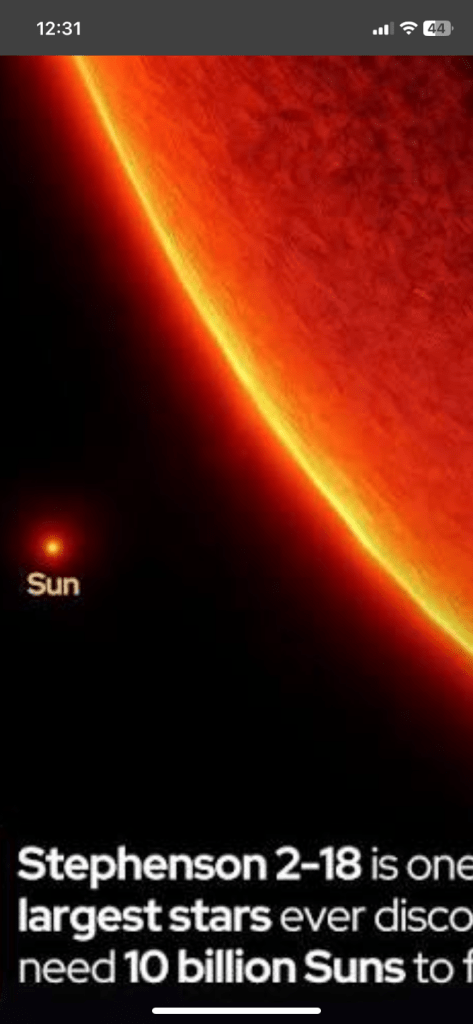
Stephenson 2-1, also known as Stephenson 2 DFK 1 or Stephenson 2-18 (St2-18), is a red supergiant or potentially red hypergiant star near the open cluster Stephenson 2 in the constellation Scutum. It is considered one of the largest and most luminous stars in the Milky Way galaxy.
🌟 Key Properties of Stephenson 2-18
• Classification: It is typically classified as a Red Supergiant (RSG), though some evidence, like its significant infrared excess, suggests it could be an extreme Red Hypergiant (RHG).
• Location: It lies near the Stephenson 2 open cluster in the constellation Scutum, approximately 19,000 light-years (or 5.8 \text{ kpc}) away in the Scutum–Centaurus Arm of the Milky Way galaxy.
• Temperature and Spectral Type:
• Its estimated effective temperature is very cool for a supergiant, around 3,200 \text{ K} (or 2,926^\circ\text{C}).
• Its spectral type is unusually late, typically designated as \sim\text{M}6.
• Luminosity: St2-18 is highly luminous, though estimates vary widely. A common figure derived from its properties is nearly 440,000 times the luminosity of the Sun (L_{\odot}), placing it among the most luminous red supergiants. More recent estimates go as high as 630,000 L_{\odot}.
• Size (Radius):
• Based on the luminosity and temperature estimates, the radius is often calculated to be around 2,150 times the radius of the Sun (R_{\odot}).
• This immense size would give it a volume nearly 10 billion times that of the Sun. If placed at the center of our Solar System, its photosphere would extend far past the orbit of Saturn.
• Important Note: These extreme size and luminosity estimates are debated among astronomers. The calculated radius of 2,150 R_{\odot} exceeds the theoretical upper limit for Red Supergiants (around 1,500 R_{\odot}), and the star’s distance and cluster membership are uncertain. If it is not a member of the Stephenson 2 cluster (meaning it is closer to Earth), its luminosity and size would be significantly lower
As of now, no planets have been confirmed to orbit Stephenson 2-18 (St2-18).
Here is a breakdown of why finding planets around such a massive star is challenging and what astronomers theorize:
🔭 Challenges in Detection
1. Distance and Size: Stephenson 2-18 is approximately 19,000 light-years away. Detecting small, dim planets around such a distant and massive, but very cool and red, star with current technology is extremely difficult. Most exoplanet detection methods (like the transit method or radial velocity method) work best for stars that are much closer and less luminous in the infrared.
2. Stellar Activity: Red Supergiants like St2-18 lose mass at an extreme rate through powerful stellar winds. This outflow of material could interfere with the long-term stability of a protoplanetary disk and make any transit signals from a planet less clear.
⭐ Theoretical Possibilities
Despite the detection challenges, there are theoretical reasons why Stephenson 2-18 could have planets:
• Massive Protoplanetary Disk: As a very massive star (\sim 10-30 times the mass of the Sun, M_{\odot}), St2-18 would have formed from a very large amount of material, which could result in a more massive and extensive protoplanetary disk (the disk of dust and gas from which planets form).
• Wider Stable Orbits: Due to its greater mass and resulting higher gravity, planets could potentially maintain stable orbits at much greater distances than in our Solar System.
• Habitable Zone: The theoretical habitable zone for a star as luminous as St2-18 is estimated to be incredibly far out, potentially between 650 to 1,400 Astronomical Units (AU) (where 1 \text{ AU} is the distance from the Earth to the Sun). Planets in these distant, vast orbits would be incredibly challenging to find.
• Short Lifespan: However, massive stars like Stephenson 2-18 have extremely short lifespans (only tens of millions of years, compared to the Sun’s 10 billion years). This short time frame might not be long enough for planets, especially gas giants and distant ones, to fully form and settle into stable orbits. It is also possible that any inner planets were consumed when the star swelled into its current immense size .
In summary, while no planets have been discovered, it cannot be ruled out that Stephenson 2-18 hosts a system of distant planets that formed very quickly or were able to survive its rapid and dramatic evolution.
This video explores the thought experiment of what would happen if Stephenson 2-18 were to replace our own Sun in the Solar System.
What If We Replaced Our Sun with Stephenson 2-18?
Please like support subscribe and write your precious comment on universe discoveries
Full article source google
 Universe discoveries
🙏🌹
Aum Shanti
LikeLiked by 1 person