
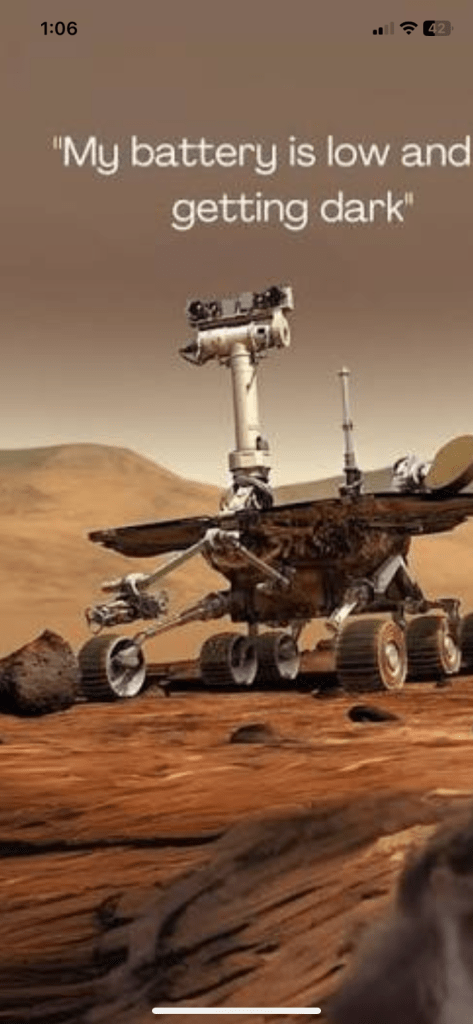
NASA’s Opportunity rover touched down on Mars on January 25, 2004, as part of the Mars Exploration Rover mission. It was designed for a short journey—just 90 Martian days and a drive of about one kilometer. What followed instead became one of the most remarkable stories in space exploration. Opportunity kept going for nearly 15 years, traveling more than 45 kilometers (28 miles) across the Martian surface and far exceeding every expectation placed upon it.In June 2018, Mars was engulfed by a planet-wide dust storm. Thick clouds of dust blotted out sunlight, leaving Opportunity’s solar panels unable to recharge its batteries. Slowly, the rover lost power and fell silent. For the next eight months, NASA engineers tried relentlessly to reach it, sending more than a thousand commands in hopes of hearing back.The silence never broke. On February 13, 2019, NASA officially declared the mission complete.The famous “final words” were not a direct message, but a poetic interpretation by a NASA engineer of the rover’s last telemetry—data showing fading power and dim light. Yet those words resonated deeply.They came to represent something larger: a small robot, alone on a distant world, that worked faithfully until it could no longer see the Sun.
NASA opportunity rover achievements
NASA’s Opportunity rover, which concluded its mission in early 2019, remains one of the most successful interplanetary endeavors in history. Originally designed for a 90-day mission, it operated for nearly 15 years, fundamentally changing our understanding of Martian geology and habitability
.
Key Scientific Discoveries
- Evidence of Ancient Water: Opportunity discovered “blueberries”—small, hematite-rich spherical concretions—and gypsum veins that provided definitive evidence that liquid water once flowed on or beneath the Martian surface.
- Past Habitability: The rover identified clay minerals at Endeavour Crater, indicating that Mars once had neutral-pH (non-acidic) water, which could have supported ancient microbial life.
- First Meteorite on Another Planet: In 2005, it discovered “Heat Shield Rock,” the first meteorite of any type identified on the surface of another planet.
- Geological History: Over its 14-year journey, Opportunity studied the composition and erosion of over 100 impact craters, revealing the planet’s environmental evolution.
Record-Breaking Milestones
- Longevity: Opportunity far exceeded its planned 90-sol lifespan, operating for 5,352 sols (roughly 15 Earth years) before a massive dust storm ended its mission in 2018.
- Off-World Driving Record: It holds the record for the longest distance driven on another world, totaling 28.06 miles (45.16 kilometers).
- Marathon Achievement: On March 24, 2015, it became the first human-made vehicle to exceed a marathon distance (26.2 miles) on another world.
- Extreme Navigation: The rover successfully navigated slopes as steep as 32 degrees, the steepest ever climbed by a Mars rover.
Visual and Technical Legacy
- Massive Image Archive: It returned more than 217,000 raw images, including 15 high-resolution 360-degree color panoramas that provided a human-scale view of the Martian landscape.
- Operational Resilience: Engineers developed innovative “driving backward” techniques to preserve failing motors and used natural “cleaning events” (wind gusts) to clear dust from its solar panels.
- Foundation for Future Missions: The technologies tested by Opportunity—such as 3D-vision navigation and autonomous hazard avoidance—are foundational to the current Curiosity and Perseverancemissions.
Please like subscribe comment your precious comment on universe discoveries
Full article source google
 Universe discoveries
Happy new year Satyam!
LikeLiked by 1 person
Same to you dear freind 🎸
LikeLiked by 1 person
🙏🌹
Aum Shanti
LikeLike
Very nice
LikeLike
I love your info on space👌🏾
LikeLike
LikeLiked by 5 people