
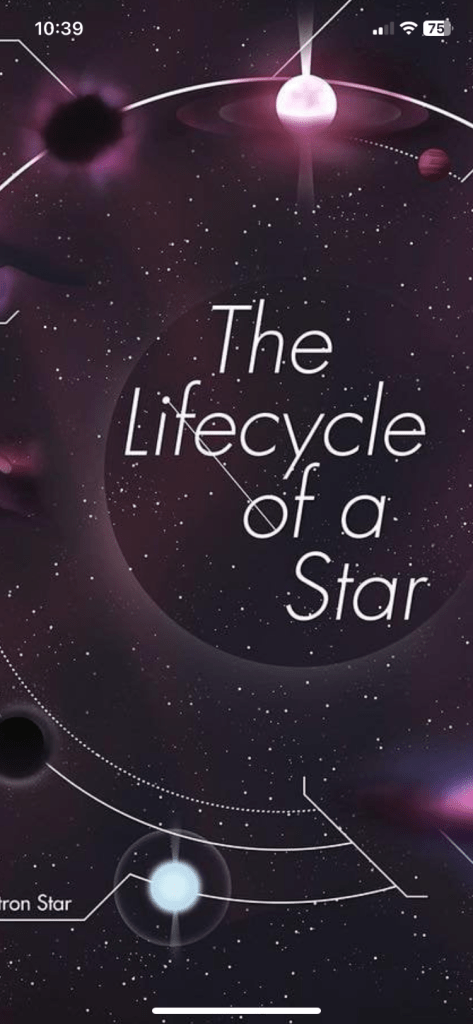
The Life Cycle from Star to Black Hole
Stars are born in cold molecular clouds of gas and dust, weighing between 1,000 and 10 million times the mass of the Sun and up to hundreds of light-years in size. Gravity compresses these dense clumps of matter, forming protostars, which eventually heat up and initiate thermonuclear fusion of hydrogen into helium. This begins the main sequence stage, the longest in a star’s life. Its duration is determined by its mass: low-mass stars can shine for trillions of years, while massive ones last only a few million years.
When the hydrogen in their core runs out, evolution takes different paths. Low-mass stars swell to giants, shed their outer layers, and become white dwarfs, which cool for billions of years.
Massive stars synthesize elements down to iron, after which the core collapses, resulting in a supernova explosion. The result is a neutron star or a black hole.
The ejected matter enriches the cosmos with heavy elements and participates in the birth of new stars, closing the cycle of stellar evolution
A star becomes a black hole by first becoming a Red Supergiant, then exploding as a Supernova, and finally, if the remaining core is massive enough (over ~3 solar masses), it collapses under its own gravity to form a black hole, a region of spacetime with gravity so intense nothing, not even light, can escape. This path is for extremely massive stars, unlike Sun-like stars that become white dwarfs.
The Journey to a Black Hole
- Nebula & Protostar: All stars start as vast clouds of gas and dust (nebulae) that collapse under gravity to form a protostar.
- Main Sequence: The protostar ignites nuclear fusion, becoming a stable main sequence star, like our Sun, burning hydrogen.
- Red Supergiant: When massive stars exhaust their core hydrogen, they swell into Red Supergiants, fusing heavier elements.
- Supernova Explosion: The core collapses, triggering a massive explosion called a supernova, scattering elements into space and leaving behind a dense core.
- Black Hole Formation: If the core’s mass is significantly greater than the Sun’s (about 3-4 times or more), its gravity overwhelms all other forces, crushing it into a single point (singularity) and forming a black hole.
Key Characteristics of a Black Hole
- Extreme Gravity: So strong that it warps spacetime and traps light.
- Singularity: The infinitely dense point where the star’s mass collapses.
- Event Horizon: The boundary around the singularity, the point of no return.
This cycle demonstrates how stellar mass dictates a star’s ultimate fate, turning some of the universe’s biggest stars into the most extreme objects, black holes.
Please like subscribe comment your precious comment on universe discoveries
Full article source google
 Universe discoveries
This is a clear, engaging, and well-structured overview of stellar evolution that makes a complex subject accessible without losing its scientific depth. You guide the reader smoothly from star birth to black hole formation, emphasizing the crucial role of mass in determining a star’s fate. I especially appreciate how you connect cosmic destruction with creation, highlighting the cyclical nature of the universe. An informative and inspiring piece that sparks curiosity about the vast mechanics of the cosmos.
LikeLike
🙏🌹
Aum Shanti
LikeLike
Very nice information
LikeLike