
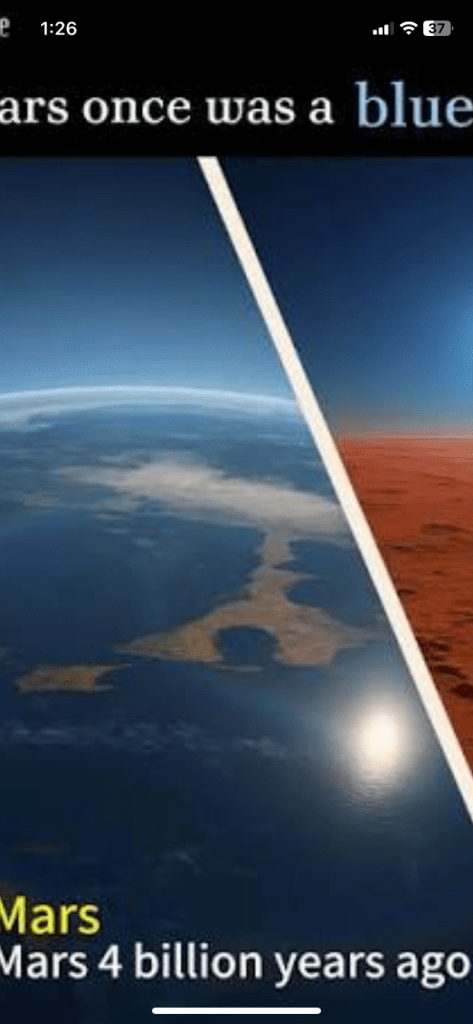
Mars was a “blue planet” around three billion years ago
The existence of water on Mars is a central topic in planetary research. Previous studies have already provided evidence of oceans and rivers on Mars, indicating a once humid and possibly habitable environment. Evidence of former water and a possible ocean have also been discovered for the Valles Marineris – the largest canyon system on Mars, which stretches along its equator. These come, among other things, from discoveries of minerals that have been altered by water.
A research team from the University of Bern, in collaboration with the INAF – Osservatorio Astronomico di Padova, has now gained new insights into the geological past of Valles Marineris: Using high-resolution images from various Mars cameras, the researchers have found geomorphologic structures near the canyon system that resemble river deltas on Earth. These structures represent the mouth of a river into an ocean. The new study thus provides clear evidence of a coastline and consequently of an earlier ocean on Mars. The study was recently published in the journal npj space exploration.
Scientific evidence from recent studies in 2025 and 2026 confirms that Mars was a “blue planet” approximately three billion years ago, significantly different from the dry, red desert seen today.
Geological Evidence of a “Blue Planet”
- Northern Ocean: Researchers from the University of Bern identified high-resolution geomorphological structures near Valles Marineris that resemble Earth-like river deltas. These structures represent river mouths that once emptied into a vast ocean covering the northern hemisphere.
- Ocean Size: The ancient ocean is estimated to have been at least as large as Earth’s Arctic Ocean.
- Coastal Deposits: Data from China’s Zhurong rover at Utopia Planitia revealed buried sedimentary formations and “pitted cones” similar to terrestrial beach deposits and mud volcanoes, suggesting long-term stable water conditions.
- Water Volume: Seismic data from NASA’s InSight lander suggests a large reservoir of liquid water remains trapped 10–20 kilometers underground, enough to have once covered the entire surface in an ocean up to 2 kilometers deep.
Climate and Appearance
- Atmosphere: Three billion years ago, Mars possessed a thicker atmosphere and a warmer climate capable of sustaining liquid surface water before a major transition to arid conditions.
- Surface Color: Before the iron-rich soil oxidized into its current red hue, the planet likely appeared gray or blue due to its vast water bodies and un-rusted silicates.
- Habitability: The presence of these stable deltas and oceans indicates that Mars once had environments potentially favorable for the emergence of microbial life.
Please like subscribe comment your precious comment on universe discoveries
Full article source google
 Universe discoveries
Nice information.
LikeLike
🙏🌹
Aum Shanti
LikeLiked by 1 person