
The universe’s loudest baby shower. 🍼💥
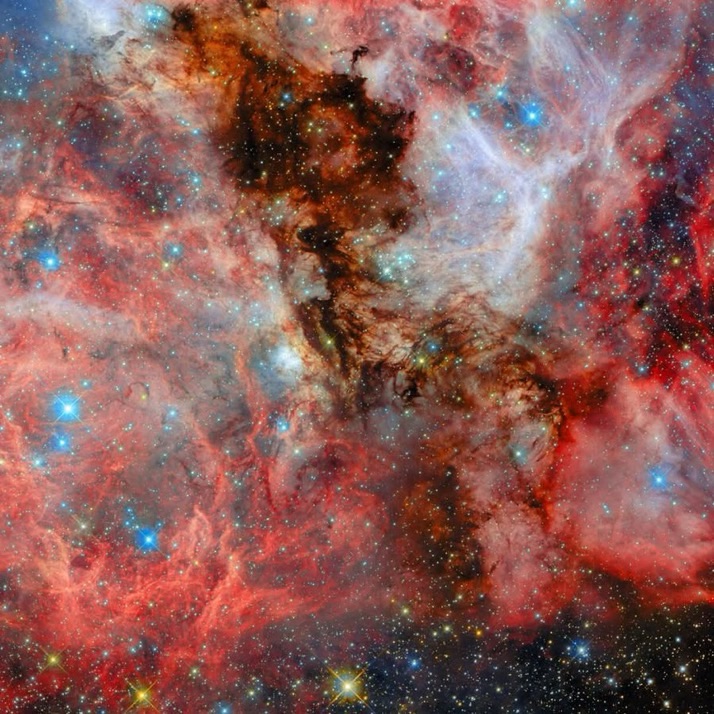
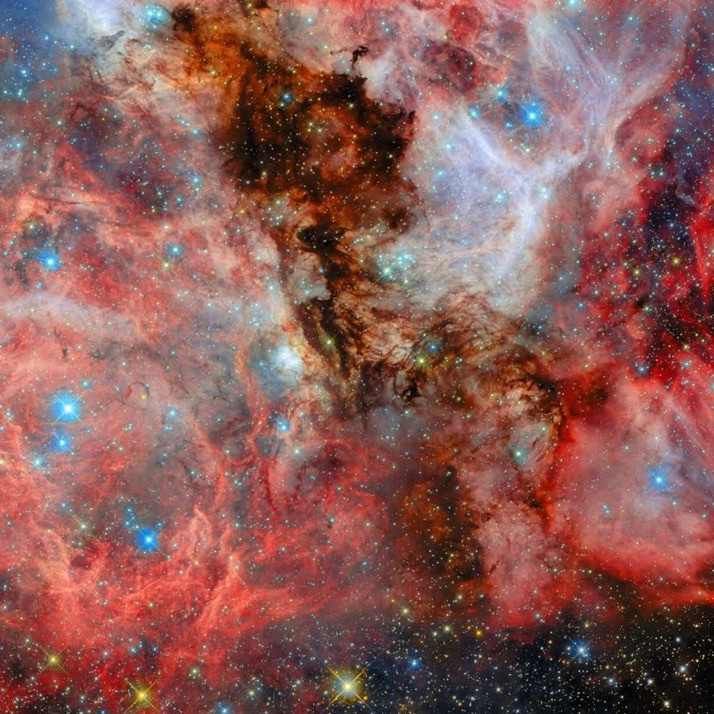
This colorful image portrays a vibrant star-forming complex known as N159, located in the Large Magellanic Cloud—a dwarf galaxy orbiting the Milky Way. N159 lies about 160,000 light-years from Earth in the constellation Dorado.
Spanning more than 150 light-years across, N159 is one of the most massive star-forming regions in the Large Magellanic Cloud. The scene is filled with thick clouds of hydrogen gas, forming an intricate network of filaments, ridges, and cavities. Embedded within these dense clouds are newly born stars. These extremely young stars are highly energetic, blasting their surroundings with intense radiation that causes the hydrogen gas to glow in red wavelengths. The brightest regions mark the locations of the hottest, youngest, and most massive stars. Their powerful radiation and fierce stellar winds sculpt the surrounding material, carving out cavities and bubble-like structures.
This spectacular image was released on 29 December 2025 and is a composite of observations taken in multiple optical wavelength bands by the Advanced Camera for Surveys on the Hubble Space Telescope.
In astronomical terms, the “loudest shower” in the universe refers to
N159, a massive star-forming region located approximately 160,000 light-years away. While space is a vacuum and cannot carry traditional sound waves, scientists often use the term metaphorically to describe the high-energy “baby shower” of newly born stars that blast their surroundings with intense radiation and fierce stellar winds.
The Astronomical “Loudest Shower”
The term “loudest baby shower” is frequently used by NASA and astronomical organizations to describe N159, a vibrant star-forming complex in the Large Magellanic Cloud.
- The “Sound” of Creation: This region is a “noise” of activity where young, energetic stars sculpt the surrounding hydrogen gas into filaments, ridges, and bubble-like cavities.
- Scale: N159 spans over 150 light-yearsacross and contains some of the hottest and most massive stars known, which cause the gas to glow intensely.
- Cosmic Comparison: In a broader context of “loud” cosmic events, the most powerful actual acoustic-equivalent energy comes from black hole mergers, which produce gravitational waves often converted into sound for research.
What is cosmic shower
A cosmic shower, also known as a cosmic ray shower or extensive air shower (EAS), is a vast cascade of secondary subatomic particles produced when a high-energy particle from space (a primary cosmic ray) strikes the Earth’s atmosphere
Think of it like a cosmic “break shot” in billiards: a single, incredibly fast-moving particle hits the atmosphere and shatters into billions of smaller pieces, which then hit other particles, creating a wide “shower” of radiation and matter that can cover several square kilometers by the time it reaches the ground.
How the Shower Occurs
The process happens in a rapid chain reaction:
1. The Collision: A primary cosmic ray—usually a proton or a helium nucleus—travels at nearly the speed of light. It strikes a nitrogen or oxygen nucleus in the upper atmosphere.
2. The Cascade: This collision produces “secondary” particles like pions.
• Neutral pions quickly decay into high-energy photons (gamma rays).
• Charged pions can decay into muons and neutrinos.
3. Multiplication: These secondary particles then collide with other atmospheric atoms or decay further. This creates a geometric growth of particles (electrons, positrons, and more photons).
4. Ground Reach: If the initial particle had enough energy (often exceeding 10^{14} eV), the shower can reach the Earth’s surface.
Composition of the Shower
By the time the shower reaches the ground, its “flavor” has changed significantly from the original particle. It is generally divided into three components:
• Electromagnetic Component: Mostly photons, electrons, and positrons. This makes up the bulk of the particles in the shower.
• Muon Component: Muons are like “heavy electrons.” They are highly penetrating and can even be detected deep underground.
• Hadronic Component: Protons, neutrons, and mesons that stay near the central core of the shower.
Why Do We Study Them?
Since primary cosmic rays are often blocked or transformed by the atmosphere, we cannot easily study them directly from the ground. Scientists use large arrays of detectors (like the Pierre Auger Observatory) to catch these showers. By measuring the spread, timing, and types of particles in a shower, researchers can work backward to figure out the energy, direction, and origin of the original cosmic ray—helping us understand phenomena like supernovae and black holes.
What Is A Cosmic Ray Air Shower?
This video provides a visual breakdown of how primary cosmic rays trigger secondary particle cascades in our atmosphere.
Please like subscribe comment your precious thoughts on universe discoveries


🙏🌹
Aum Shanti
LikeLike
This is a wonderfully engaging and well-explained piece. You’ve taken a complex astronomical concept and transformed it into something vivid, accessible, and genuinely exciting. The metaphor of a “baby shower” and the billiards-style cascade makes the science feel alive, while the balance between poetic imagery and solid scientific explanation is impressive. It sparks curiosity and invites readers to look at the universe with fresh wonder. A beautiful blend of knowledge, imagination, and enthusiasm—truly inspiring for anyone fascinated by the cosmos. 🌌✨
LikeLike
Very nice
LikeLiked by 1 person