
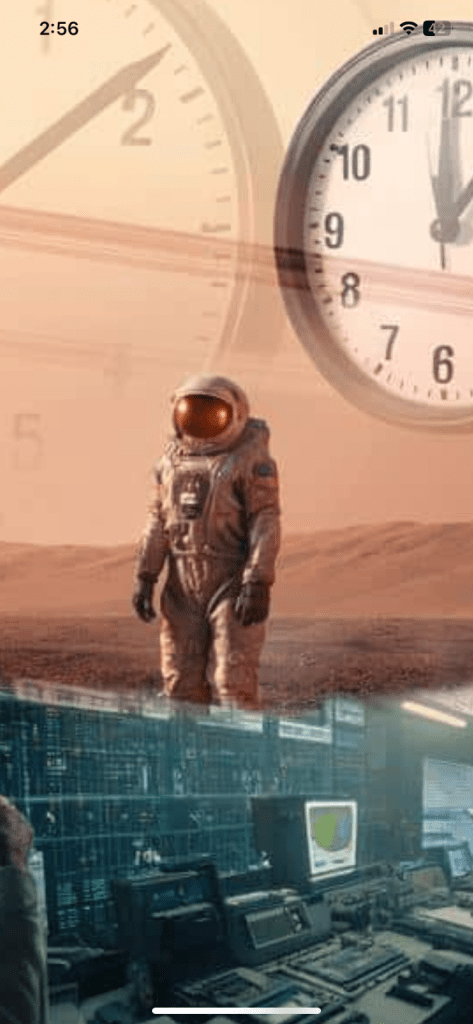
At 3:17 a.m. in Pasadena, the mission control room looked like a strange mix of a casino and a monastery. Screens glowed blue, coffee cups trembled in tired hands, and every eye was pinned to a countdown that… refused to cooperate. The landing signal from the Mars lander was “late” by a few precious microseconds. Not enough to panic. Just enough to prickle the back of your neck.
Engineers zoomed in on the data. The clocks on Earth and the clocks on Mars told slightly different stories, like two honest witnesses who remembered the same event with a fraction of a second’s disagreement.
Einstein had warned us.
Time itself was bending, and on the Red Planet, it no longer ticked quite like ours.
Einstein’s strange idea just got a Martian reality check
Albert Einstein never walked on Mars, but his equations did the trip long before any rover. When he published general relativity more than a century ago, he proposed something outrageous for his time: gravity doesn’t just pull on objects, it stretches and warps time itself.
For decades, that sounded like pure abstraction. A thing for blackboards and chalk dust, not dusty red deserts. Now, ultra-precise atomic clocks and radio signals bouncing between Earth and Mars are quietly confirming it: **time on Mars is not flowing at the same rate as time on Earth**.
Scientists at the National Institute of Standards and Technology (
NIST) recently confirmed Einstein’s prediction that time flows differently on Mars due to the effects of general relativity. Because Mars has weaker gravity and a different orbital speed compared to Earth, clocks there tick slightly at a different rate.
Key Findings
- Faster Ticking: On average, a clock on the Martian surface ticks 477 microsecondsfaster per day than a clock on Earth.
- Variable Drift: This difference is not constant; it fluctuates by up to 226 microseconds daily throughout the Martian year due to Mars’ eccentric (egg-shaped) orbit and the gravitational pull of neighboring planets.
- The Cause: Einstein’s theory states that time moves slower in stronger gravity (Earth) and faster in weaker gravity (Mars).
Impact on Future Missions
- Navigation & Communication: Precise timing is vital for landing spacecraft and maintaining a “solar-system-wide internet”. Even microsecond errors can cause significant drift over long-distance trajectories.
- Time Standards: Space agencies are discussing a “Mars Coordinated Time” to synchronize landers, orbiters, and future human habitats.
- Human Adaptation: Astronauts will likely use dual-display watches showing both Earth and Martian time to manage daily operations and biological rhythms.
Please like subscribe comment your precious comment on universe discoveries
Full article source google
 Universe discoveries
Interesting read.
LikeLiked by 1 person
Thanks sir
LikeLiked by 1 person
You are welcome, dear.
LikeLiked by 1 person
I STILL DON’T UNDERSTAND THIS!
LikeLiked by 1 person
Sir it’s about how time flows different in universe like time 🕰️ flows different in earth and different in mars so the future man missions it will help them to adjust 🎸
LikeLiked by 1 person
🙏🏼🌹
Aum Shanti
LikeLiked by 1 person