
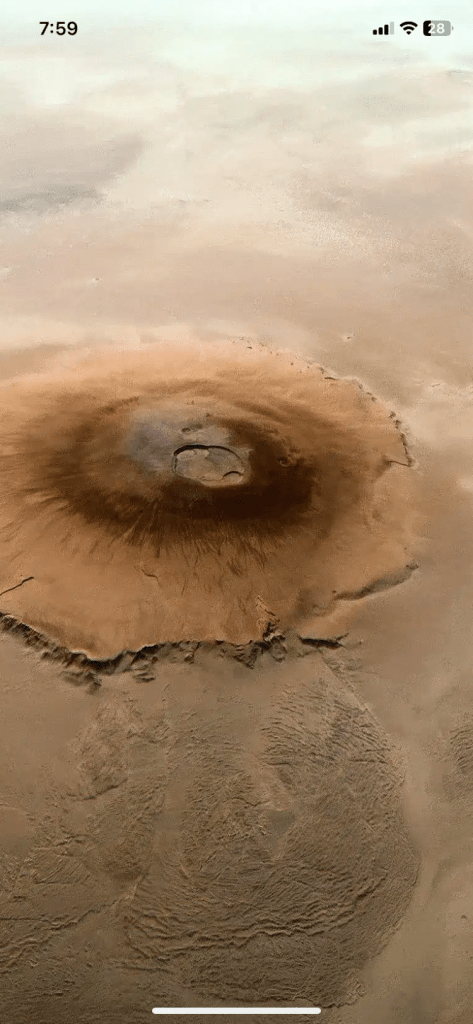
In a major discovery published in
Nature Geoscience in June 2024, scientists confirmed the presence of water frost on the summit of Olympus Mons, the Solar System’s largest mountain. This marks the first time water has been detected near Mars’ equator, a region previously thought too warm to support surface ice.
Key Details of the Discovery
- The Scale: While the frost layer is incredibly thin—about the thickness of a human hair (0.01 mm)—it covers such a vast area that it represents roughly 150,000 tons of water. This is equivalent to approximately 60 Olympic-sized swimming pools.
- The Cycle: The frost is ephemeral, forming in the early morning within the mountain’s giant caldera (summit crater) and evaporating shortly after sunrise as the thin Martian atmosphere warms up.
- Detection: The discovery was made by the European Space Agency’s (ESA) ExoMars Trace Gas Orbiter and was confirmed using data from the Mars Express mission.
- Why it Forms: Researchers believe a unique microclimate is responsible. Moist air is pushed up the mountain’s slopes (upslope winds), where it cools and condenses into frost inside the caldera before the sun reaches its peak.
- Locations: In addition to Olympus Mons, frost was also detected on other massive volcanoes in the Tharsis region, including Arsia Mons, Ascraeus Mons, and Ceraunius Tholus.
This finding is significant for future human exploration, as it provides a potential—albeit difficult to harvest—water resource and helps scientists better model the Martian water cycle.
Mount Olympus on mars
If the Greek Mount Olympus is the home of the gods, Olympus Mons on Mars is the throne of the entire solar system. It is the largest volcano—and the tallest mountain—known to exist in our planetary neighborhood.
🌋 Physical Dimensions
To call it a “mountain” is almost an understatement. It is a shield volcano, similar in shape to the volcanoes in Hawaii but on a terrifyingly different scale
🚀 Why is it so big?
You might wonder why Earth doesn’t have mountains this tall. The secret lies in the fundamental differences between the two planets:
1. Low Gravity: Mars has about 38% of Earth’s gravity. This allows the mountain to grow much taller before the rock beneath it “slumps” or collapses under its own weight.
2. No Plate Tectonics: On Earth, tectonic plates move over “hotspots” (like the Hawaiian islands), creating a chain of smaller volcanoes. On Mars, the crust stays still. The lava just kept piling up in the exact same spot for billions of years.
3. High Eruption Rates: Geologists believe the lava flows on Olympus Mons were incredibly voluminous and persistent.
🧗 The “View” from the Summit
If you were standing on the edge of the volcano, you wouldn’t actually feel like you were on a peak. Because the volcano is so wide and the curvature of Mars is so pronounced, the base of the mountain would actually be beyond the horizon.
Furthermore, the summit sits so high that it is technically above the bulk of the Martian atmosphere. The sky at the top wouldn’t be the typical “butterscotch” pink of Mars; it would look like the dark void of space.
⚠️ The Basal Escarpment
One of the most unique features of Olympus Mons is its basal cliff. The perimeter of the volcano is a sheer drop-off that is up to 8 km (5 miles) high in some places. Scientists are still debating exactly how this formed, though many believe it was caused by massive landslides.
Please like subscribe comment your precious comment on universe discoveries
Full article source google
 Universe discoveries
🙏🌹
Aum Shanti
LikeLike
Great information 👌🏾
LikeLiked by 2 people