
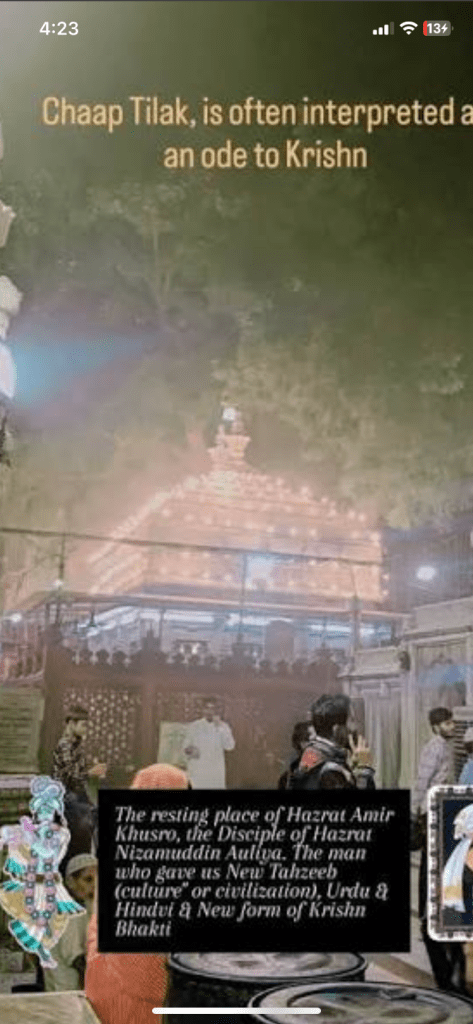
Chhap Tilak Sab Chhini Re” is a famous Sufi Qawwali written by the 14th-century Sufi poet
Amir Khusrau to express his total surrender and devotion to his spiritual master, Nizamuddin Auliya. While rooted in Sufi tradition, it is widely sung in Prabhu Bhakti(devotion to God) as a song of love for Lord Krishna, portraying the divine stealing the devotee’s identity and ego upon their first meeting.
Key Themes in the Context of Bhakti
- Total Surrender: The phrase “Chhap tilak sab chhini re mose naina milayike” means “You have taken away my looks and my identity just by a glance”.
- Divine Love: It represents the moment the soul (Jivatma) connects with the Supreme (Paramatma), losing all worldly pride.
- Metaphorical Union: The song describes the lover (devotee) losing their self-consciousness and adopting the appearance of the beloved (God), often performed in a Krishna-bhakti context.
Famous Versions
- Traditional: Riza Khan & Bali Thakre
- Contemporary/Bhajan: Jaya Kishori, Vinod Agarwal, Master Saleem.
- Classical: Pooja Gaitonde.
Lyrics (Sample)
Chhap tilak sab chhini re mose naina milayike
Apni si rang di mose naina milayike
Prem bhatti ka madhva pilaike
Matwali kar lini re mose naina milayike
Chhap tilak sab chhini re mose naina milayike
Amir khusro
Amir Khusro (1253–1325), also known as Tuti-e-Hind (the “Parrot of India”), was a legendary Sufi musician, poet, and scholar during the Delhi Sultanate. He is considered the “Father of Qawwali” and played a vital role in blending Persian and Indian cultures.
Key Facts and Contributions
- Spirituality: He was the most devoted disciple of the Sufi saint Nizamuddin Auliya.
- Poetry: He wrote in Persian and Hindavi(an early form of Hindi/Urdu), making him the “Father of Urdu Literature”.
- Music: He is credited with inventing the Sitar and Tabla, and introducing musical forms like Ghazal, Tarana, and Khayal.
- Court Life: He served as a court poet for seven (some sources say up to ten) different rulers of the Delhi Sultanate, including Alauddin Khilji.
- Notable Works:
- Khaliq-e-bari: The world’s first printed dictionary (Persian-Hindi).
- Songs: Famous compositions like Chaap Tilak Sab Chheeni, Aaj Rang Hai, and Man Kunto Maula.
- Folklore: He is well-known for his playful riddles (Pahelis) and “Do Sukhna”.
Please like subscribe comment your precious comment on universe discoveries
Full article source google
 Universe discoveries
🙏🧘🏼♂️
Aum Shanti
LikeLiked by 1 person