
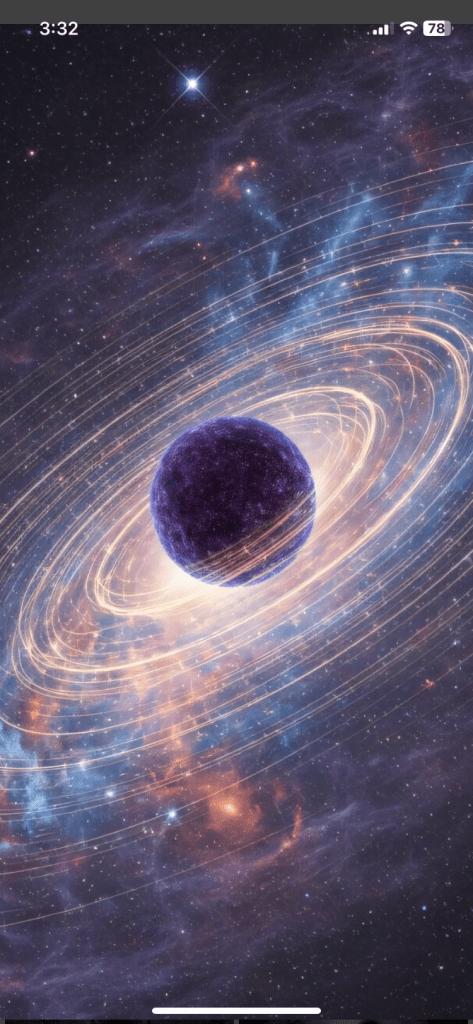
Recent research published in the
Monthly Notices of the Royal Astronomical Societysuggests that the supermassive object at the center of the Milky Way, Sagittarius A*, might not be a black hole at all, but rather a dense, compact core of dark matter.
How Dark Matter Mimics a Black Hole
Astronomers have identified several ways a clump of dark matter could masquerade as a black hole:
- Gravitational Influence: A dense core of fermionic dark matter (light subatomic particles) can exert a gravitational pull identical to a black hole. This explains the blistering speeds of “S-stars” that whip around our galaxy’s center.
- Shadow Casting: Simulations show that if glowing gas and dust were to swirl around a dark matter core, it would produce a “shadow” strikingly similar to the famous image captured by the Event Horizon Telescope (EHT).
- Light Bending: Because the core is so dense and massive, it bends light strongly, creating a central darkness surrounded by a bright ring—the same visual signature used to identify black holes.
Why This Matters
- Unified Theory: Unlike the black hole model, which focuses on the center, the dark matter model connects the galactic core to the vast dark matter halo that shapes the rotation of the entire galaxy.
- Solving the Origin Mystery: It could explain how supermassive black holes formed so quickly in the early universe; dense dark matter clumps might simply collapse into black holes once they reach a critical mass.
Testable Differences: While current data cannot decisively choose between the two, future observations using the GRAVITY interferometer will look for “photon rings”—a feature unique to black holes that would be absent in a dark matter core.
What is dark matter and it’s significance
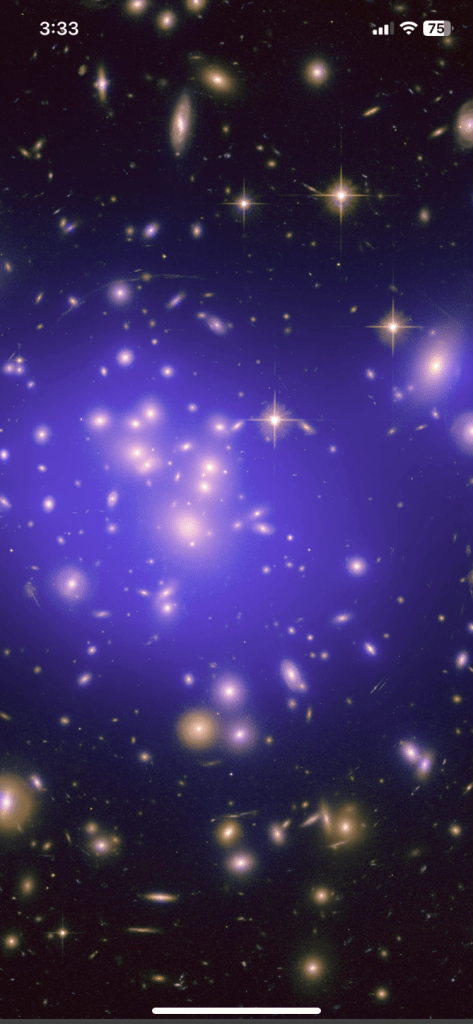
It is fascinating to think that everything we can see—stars, planets, trees, and people—makes up only about
5% of the universe. The rest is a mystery, with dark matteraccounting for roughly 27% of the cosmos.
What is Dark Matter?
Dark matter is an invisible substance that does not emit, absorb, or reflect light (electromagnetic radiation). We know it exists not because we can see it, but because we can see its gravitational effects on the visible world.
Think of it like the wind: you can’t see the air itself, but you can see the leaves moving on a tree.
- It’s “Dark”: It doesn’t interact with light, making it invisible to telescopes.
- It’s “Matter”: It has mass and exerts a gravitational pull.
- It’s Transparent: It passes straight through “normal” matter (and you!) without leaving a trace.
Why is it Significant?
Without dark matter, the universe as we know it simply wouldn’t work. Here is why it is the “cosmic glue” of our existence:
Galaxies spin so fast that the gravity from visible stars isn’t enough to hold them together. Dark matter provides the extra “weight” needed to prevent stars from flying off into deep space
In the early universe, dark matter clumped together first. Its gravity acted as a “scaffold,” pulling in gas and dust to form the very first stars and galaxies.
Dark matter is so massive it can warp the fabric of space-time. We can observe it bending light from distant galaxies, acting like a giant magnifying glass in space
What is it made of?
Scientists aren’t 100% sure yet, but the leading theories involve particles that don’t fit into our current “Standard Model” of physics:
- WIMPs (Weakly Interacting Massive Particles): Heavy particles that only interact via gravity and the “weak” nuclear force.
- Axions: Extremely light, theoretical particles that could solve other problems in quantum physics.
- Fermionic Dark Matter: As mentioned in our previous talk, these could be “Darkinos”—particles that can pack tightly together to mimic the density of a black hole.
Fun Fact: If you held out your hand, trillions of dark matter particles would pass through it every second, yet they wouldn’t touch a single atom in your body
Dark energy and it’s role to dark matter
While dark matter and dark energy share the name “dark” (meaning we can’t see them),
they are actually cosmic rivals. If the universe were a movie, dark matter would be the “glue” trying to pull everything together, while dark energy would be the “expander” trying to push everything apart.
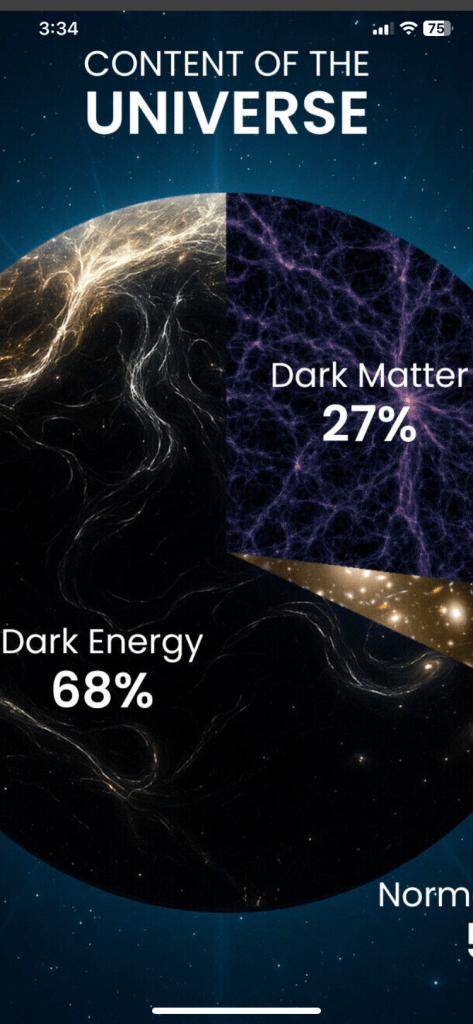
Together, they make up about 95% of the universe:
- Dark Matter: ~27%
- Dark Energy: ~68%
- Normal Matter: ~5% (Everything we’ve ever seen)
What is Dark Energy?
Dark energy isn’t “matter” at all; it is thought to be a property of space itself. In the 1990s, astronomers expected the expansion of the universe to slow down because of gravity. Instead, they found the expansion is speeding up. Dark energy is the mysterious force driving this acceleration.
The Tug-of-War: Dark Matter vs. Dark Energy
The history of our universe is defined by the competition between these two invisible forces.
Dark Matter (The Glue). Dark Energy (The Expander). RoleAttracts.It pulls matter together via gravity. Repels. It pushes the fabric of space apart.
The “Brakes” of the early universe. ( dark matter)
The “Accelerator” of the modern universe. ( dark energy)
Their Relationship: The “Cosmic Web”
Dark energy and dark matter work together to create the Cosmic Web—the largest structure in the universe.
- Dark Matter creates the “threads” of the web. It pulls gas and dust into long filaments where galaxies grow.
- Dark Energy acts on the “voids” (the empty spaces between the threads). It stretches these voids, pushing the filaments further away from each other.
The Fate of the Universe
Because dark energy makes up 68% of the universe and its density doesn’t seem to dilute, it is currently winning the war.
In billions of years, dark energy may push galaxies so far apart that an observer in the Milky Way would see a completely empty sky—every other galaxy would be moving away faster than the speed of light, becoming invisible to us forever. This theory is known as the “Big Freeze.”
Please like subscribe comment your precious comment on universe discoveries
Full article source google
 Universe discoveries
This is a fascinating and well-articulated exploration of a cutting-edge idea in astrophysics. I really appreciate how clearly you break down a complex concept—especially the way you explain how dark matter could mimic a black hole without oversimplifying the science. The structure flows logically from observation to implication, making it engaging even for non-specialist readers.
LikeLiked by 1 person
Thanks sir dark matter and dark energy are very fascinating subject 🎸
LikeLiked by 1 person
You’re most welcome 🙂
They truly are fascinating—so much mystery, so many unanswered questions. The fact that most of the universe is shaped by things we can’t even see keeps the sense of wonder alive. Always happy to explore these cosmic ideas with you 🎸✨
LikeLike
🙏🌹
Aum Shanti
LikeLike
That’s very interesting thank you for sharing.
LikeLiked by 1 person