
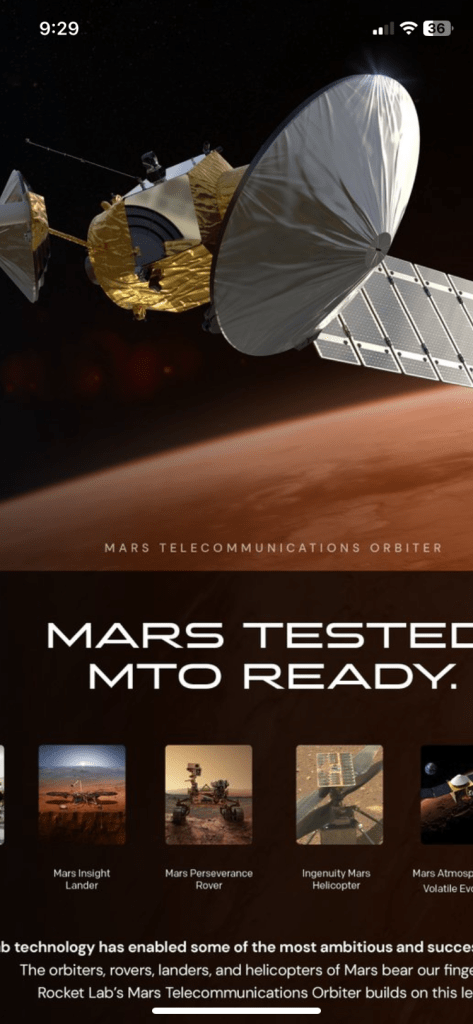
NASA’s Mars objectives are clear: Seek signs of ancient life, characterize the Red Planet’s climate and geology, and prepare for future human exploration.
Rocket Lab’s Mars Telecommunications Orbiter will enable this. It’s the invisible infrastructure that makes @NASA’s entire Mars strategy possible.
1. Without communications, Mars missions simply don’t work
NASA’s Mars missions have transformed humanity’s understanding of the Red Planet. Orbiters have mapped its surface in extraordinary detail. Rovers have found evidence of ancient lakes and rivers. The next generation of missions will go even further, including returning samples to Earth and paving the way for humans to live and work on Mars.
But spacecraft and humans at Mars can’t send meaningful data directly back to Earth on their own. Rocket Lab’s Mars Telecommunications Orbiter will be a vital relay, ensuring discoveries, images, and scientific breakthroughs actually make it home.
2. It protects billions of dollars already invested in Mars
Taxpayers have funded decades of NASA Mars missions that have delivered globally significant Mars findings. The current Mars Relay Network that these missions rely on is fragile, aging, and limited. The recent loss of contact with the MAVEN is testament that time is running out to establish new and reliable communications at Mars. Without reliable communications, the flow of data from existing spacecraft at Mars could simply dry up. MTO ensures their continuity.
It multiplies the value of every Mars mission
Rocket Lab’s Mars Telecommunications Orbiter would support dozens of spacecraft, today and into the future, dramatically increasing how much science and value each mission delivers. Just one orbiter makes every Mars mission more powerful.
4. It enables future human missions to Mars
NASA’s long-term Mars exploration strategy goes far beyond landing robots. It’s about enabling sustained exploration and ultimately, human missions. Humans on Mars will need constant communication with Earth for navigation, science operations, safety, coordination, and simple human connection. Reliable communications aren’t optional, they’re essential. Rocket Lab’s Mars Telecommunications Orbiter will be the reliable and enduring infrastructure that enables NASA’s human exploration goals at Mars.
It Commercializes Space Communications
Rocket Lab’s Mars Telecommunications Orbiter directly supports NASA’s SCaN Program’s commitment to transitioning from government-owned communications assets to commercial alternatives. This shift is about creating smarter, more cost-effective systems that ensure mission continuity for national space priorities, while reducing taxpayer costs
Rocket Lab’s
Mars Telecommunications Orbiter (MTO) is a proposed high-speed communications relay satellite designed to establish a “commercial backbone” for data transfer between Earth and Mars. The project is a central component of Rocket Lab’s broader strategy to support NASA’s Mars Sample Return (MSR) and future human exploration.
Key Mission Details
- Purpose: To provide a reliable, high-bandwidth link for existing and future Mars missions, reducing the burden on NASA’s oversubscribed Deep Space Network (DSN).
- Spacecraft Platform: The orbiter is built on Rocket Lab’s flight-proven Explorerspacecraft bus.
- Orbit: Rocket Lab proposes placing the satellite in an areosynchronous orbit—the Martian equivalent of a geostationary orbit—to ensure persistent, fixed-position coverage.
- Technology: The concept emphasizes optical (laser) communication links to achieve significantly higher data rates than traditional radio frequency systems.
Strategic Importance
- Aging Infrastructure: Current relay assets like NASA’s Mars Reconnaissance Orbiter (MRO) are aging and nearing retirement, creating an urgent need for a replacement by the late 2020s.
- Commercial Shift: The project aligns with NASA’s SCaN program, which aims to transition from government-owned to commercially-provided space communications services.
- Funding and Timeline: A 2026 U.S. budget bill allocated $700 million for the development of a commercial MTO, with a target delivery date of 2028.
Competitive Landscape
Rocket Lab is competing for the contract against other major aerospace players, most notably Blue Origin, which has proposed its own MTO concept based on its “Blue Ring” platform. Rocket Lab highlights its “Mars DNA,” citing its successful delivery of the ESCAPADE twin spacecraft (which launched in November 2025) as evidence of its deep-space readiness. please like subscribe comment your precious comment on universe discoveries
Full article source google
 Universe discoveries
🙏🌹
Aum Shanti
LikeLiked by 1 person
Very nice topic and most importantly way of expressing
LikeLiked by 1 person
Thanks
LikeLike