
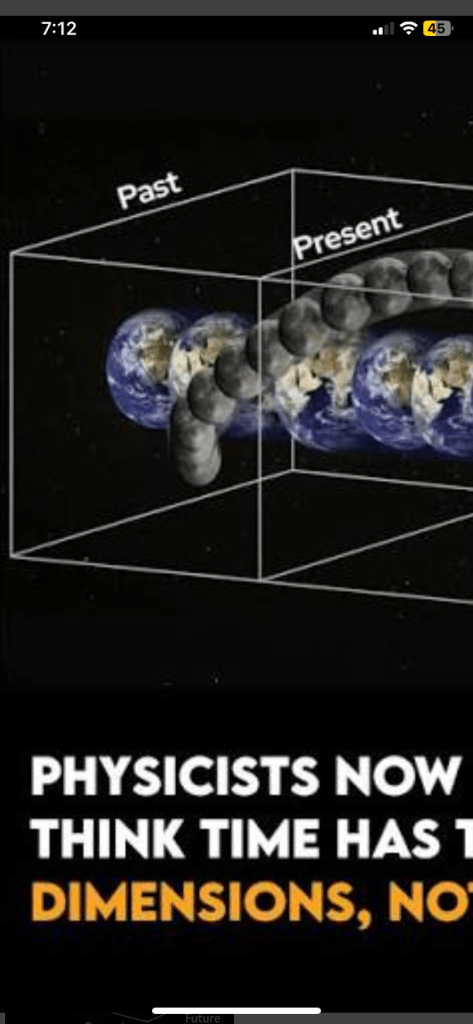
Recent theoretical physics research, notably a 2025 paper by Dr. Gunther Kletetschkafrom the University of Alaska Fairbanks, proposes that the universe is structured with three dimensions of time and three dimensions of space. In this framework, time is the primary “canvas” of reality, and what we perceive as 3D space is actually an emergent byproduct or “paint” on that temporal foundation.
The Three Axes of Time
Unlike the traditional view of time as a single forward-moving arrow, this model suggests three distinct temporal axes that govern reality at different scales:
- The Quantum Scale (t1𝑡1): Governs subatomic particle interactions and quantum mechanical behavior.
- The Interaction Scale (t2𝑡2): Mediates between the quantum and classical worlds, helping explain particle generations and weak interactions.
- The Cosmological Scale (t3𝑡3): Controls large-scale structures, the evolution of the universe, and gravitational phenomena.
Key Theoretical Implications
This “time-first” approach is significant because it claims to resolve major unanswered questions in physics:
- Particle Masses: The theory accurately reproduces the known masses of fundamental particles like electrons, muons, and quarks—values that have long lacked a deeper explanation in the Standard Model.
- Unification: It offers a potential bridge between Einstein’s General Relativity(which describes the large-scale cosmos) and Quantum Mechanics (which governs the subatomic world), moving science closer to a “Theory of Everything”.
- Preserving Causality: Despite having multiple time directions, the model maintains the principle of cause and effect. While it allows for “sideways” movements into alternate versions of the present, causes must still precede effects.
- Quantum Explanations: Phenomena like quantum entanglement are explained as direct connectivity within the 3D temporal manifold, even if the particles are separated in 3D space.
Scientific Standing
While provocative and mathematically grounded, this theory is currently considered speculative and sits on the fringe of mainstream physics. It was published in Reports in Advances of Physical Sciences, a journal noted for being relatively niche. For the theory to gain wider acceptance, it must withstand rigorous peer review in top-tier journals, undergo independent verification, and align with more experimental evidence.
Testable predictions that could validate the theory in the future include:
- Gravitational Wave Speed: The model predicts that gravitational waves might travel slightly slower than light over vast cosmic distances.
- Particle Properties: It predicts currently unknown properties of neutrinos and specific mass ratios for fermion sectors.
Please like subscribe comment your precious comment on universe discoveries
Full article source google
 Universe discoveries
Fascinating and thought-provoking overview! You’ve presented a complex and highly abstract idea—the possibility of three dimensions of time—in a clear, engaging way that sparks curiosity without losing the scientific nuance. I especially appreciate how you balanced the excitement of the theory’s implications with an honest note about its speculative status. A concise yet intriguing exploration that invites readers to think beyond conventional views of reality. 🌌
LikeLike
Very interesting, thank you.
Joanna
LikeLike
🙏🌹
Aum Shanti
LikeLike