
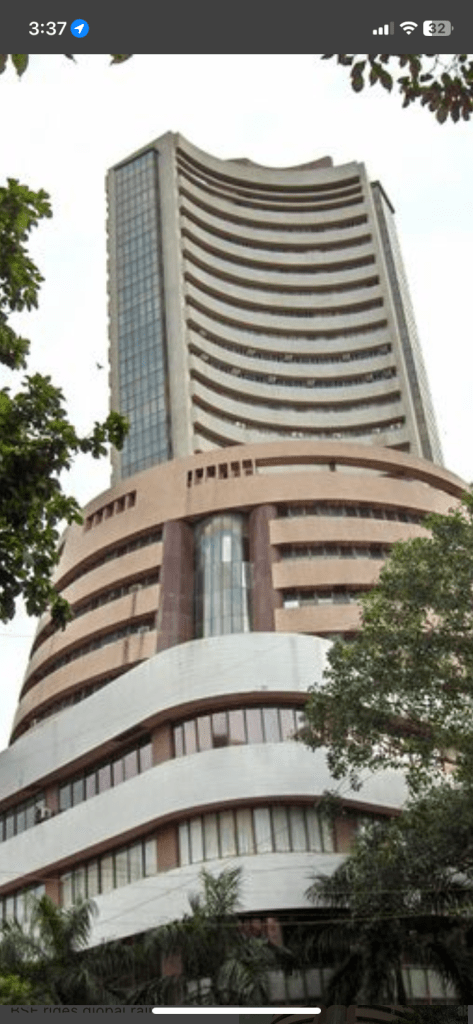
The Indian share market allows buying and selling ownership in companies through two main exchanges, the
BSE (Bombay Stock Exchange) and NSE (National Stock Exchange), regulated by SEBI. It operates via a primary market (IPO) and a secondary market for daily trading, with prices determined by demand and supply, usually trading between 9:15 am and 3:30 pm.
Key Components and Concepts
- Stock Exchange: The platform where shares are bought and sold (BSE & NSE).
- Indices: The Sensex (BSE) and Nifty 50 (NSE) track the performance of the overall market.
- Market Participants: Investors (buy for long-term), Traders (short-term profit), and Brokers (facilitate trades).
- Trading Process: Shares are bought/sold electronically and held in a Demat account.
- Primary vs. Secondary Market: Primary market is for IPOs (companies raising funds), while the secondary market is for trading existing shares.
- Key Terms:
- Bull Market: Optimistic market with rising prices.
- Bear Market: Pessimistic market with falling prices.
- Dividend: A portion of profits paid to shareholders.
- Volume: Total shares traded in a day.
Getting Started
- Open a Demat and Trading Account:Required to hold and trade shares, respectively.
- PAN Card & KYC: Mandatory documentation for regulatory compliance.
- Choose a Broker: Select a registered broker to execute trades.
- Research & Diversify: Understand company fundamentals before investing.
Regulations
The Securities and Exchange Board of India (SEBI) governs the market, protecting investor interests, regulating brokers, and ensuring transparent trading.
Technical analysis knowledge of Indian Sharemarket
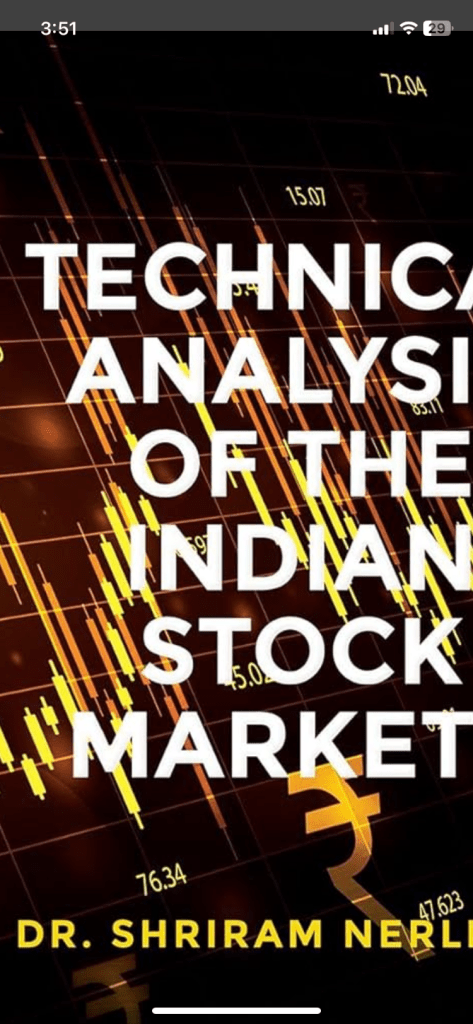
Technical analysis in the Indian share market involves analyzing historical price movements, trading volumes, and chart patterns to forecast future price directions, primarily used for short-term and intraday trading
. Key tools include candlesticks, support/resistance, moving averages, and indicators like RSI, MACD, and Fibonacci retracements.
Core Principles & Concepts
- Market Discounts Everything: Price reflects all available information and fundamentals.
- Trends & Repetition: Prices move in trends (uptrend, downtrend, sideways) and history tends to repeat itself due to investor sentiment.
- Tools: Candlestick charts, Support/Resistance, Moving Averages, and Volume analysis.
- Patterns: Reversal patterns (Head and Shoulders, Double Top) and Continuation patterns (Flags, Triangles).
Angel One +5
Key Indicators Used in India
- Moving Averages: (SMA/EMA) Help identify the trend direction.
- RSI (Relative Strength Index): Measures momentum to identify overbought (>70) or oversold (<30) conditions.
- MACD (Moving Average Convergence Divergence): Indicates changes in strength, direction, momentum, and duration of a trend.
- Fibonacci Retracement: Helps determine potential reversal levels.
Application in Indian Markets
- Timeframes: Intraday (1 min, 5 min, 15 min), Swing (Daily, Weekly).
- NSE Focus: National Stock Exchange (NSE) provides training on these methods.
- Sentiment: Used to gauge emotional, panic-driven trading by retail investors in India.
Limitations
- Technical analysis is not perfect; it provides probabilities, not certainties, and 9 out of 10 individual traders in equity F&O segments incur losses.
Disclaimer: Technical analysis is a tool, not a guarantee of profit. Always use risk management.
Sushil Kedia sees Nifty at 32,000 by year-end, indicating 28% upside from current levels
Market veteran and founder of Kedianomics, Sushil Kedia believes that the weakness in the markets is temporary, and the Nifty could rally 28 percent to hit the 32,000 mark by the end of the year.
The Nifty 50 index could breach the 32,000 level by the end of the current year, according to Sushil Kedia, founder, Kedianomics.
Speaking to Moneycontrol’s N Mahalakshmi, Kedia added that despite the markets seeing strong volatility and panic selling at the current moment, the larger picture indicates strong bullishness, with the benchmark indices likely to rally nearly 28 percent from current levels to likely top the 32,000 mark.
Kedia, however, cautioned against investors’ over-reliance on short-term forecasts. Calling forecasts his “personal pet peeve”, he said most market predictions are little more than imagination, lightly tempered by historical data.
From a statistical standpoint, he pointed out that markets have already seen a three-sigma move, a level that typically implies a very high probability of a reversal. The continuation of that move, in his view, suggests markets are overstretched rather than structurally broken.
Instead of attempting to predict an incremental downside of 2 percent on the index or 4-5 percent cuts in individual stocks, Sushil Kedia decided to advise investors to stay out when panic dominates trading.
“You do not participate when the blood is flowing on the street,” he said, adding that clarity on the trigger behind the selloff is critical. According to him, the right moment to step in is when bad news is fully disclosed and markets refuse to fall further, signalling a shift in sentiment.
Please like subscribe comment your precious comment on universe discoveries
Full article source google
 Universe discoveries
🙏🌹
Aum Shanti
LikeLike