
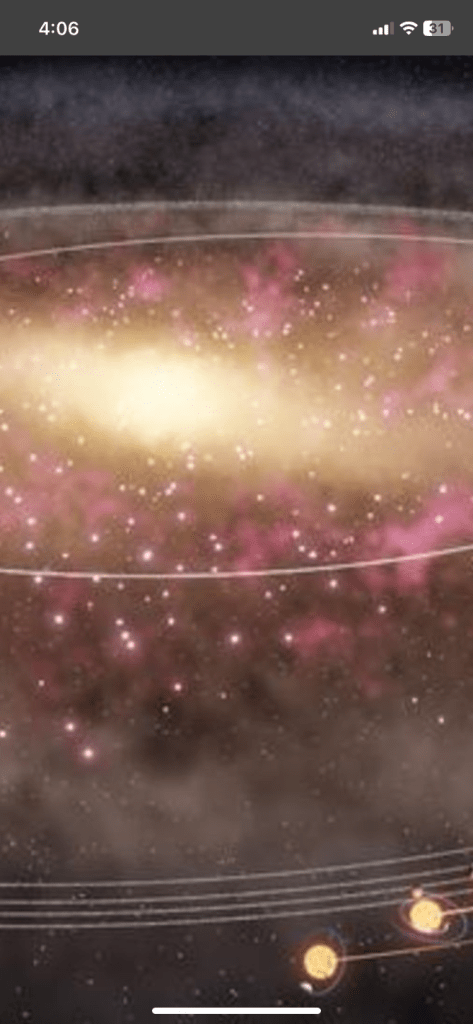
New research suggests that
a mass migration of thousands of “solar twins” — stars born around the same time and with a similar composition to our Sun — away from the Milky Way’s center may be the reason life was able to emerge on Earth. ScienceDaily +2
According to two studies published in Astronomy & Astrophysics in March 2026, our Sun likely formed roughly 10,000 light-years closer to the galactic center than it is today. Astronomy Magazine +1
Why Migration Mattered for Life
The movement provided a “best of both worlds” scenario for our solar system:
- A Resource-Rich Birthplace: The inner galaxy is dense with “heavy” elements like iron, silicon, and magnesium. These materials were essential for forming rocky planets like Earth.
- A Safe Haven: The galactic center is a “hellish” environment where high-energy events like supernovae and intense cosmic radiation occur much more frequently. These events can strip away planetary atmospheres or sterilize entire worlds.
- Stability: By migrating to the “quiet suburbs” of the galaxy’s outer disk approximately 4 to 6 billion years ago, the Sun moved into a stable region where life had the billions of years it needed to evolve undisturbed.
Yahoo +5
The Galactic Slingshot
Using data from the ESA Gaia Space Telescope, astronomers found that this migration wasn’t accidental. They propose that the formation of the Milky Way’s central bar (a massive rotating structure of stars and gas) acted as a gravitational slingshot, propelling the Sun and its siblings outward before a “corotation barrier” could form and trap them in the dangerous center.
Why there is life in our solar system
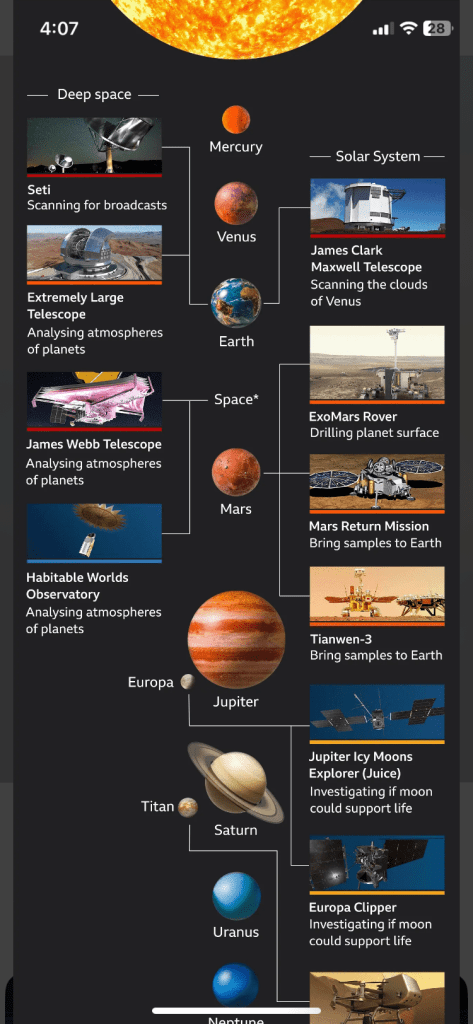
The presence of life in our solar system—specifically on Earth—is the result of a “perfect storm” of cosmic, chemical, and geological factors.
While the recent “mass migration” theory explains how our Sun moved to a safer part of the galaxy, several other key conditions had to be met:
1. The “Goldilocks” Zone
Earth sits at the perfect distance from the Sun where it is neither too hot nor too cold. This allows liquid water to exist on the surface, which is the essential solvent for all known biological processes.
2. A Protective Shield
- Magnetic Field: Earth’s molten iron core creates a magnetosphere that deflects lethal solar radiation and prevents the solar wind from stripping away our atmosphere.
- Atmosphere: Our air provides pressure, traps heat (the greenhouse effect), and contains the oxygen and carbon dioxidenecessary for life.
3. The Right Chemistry
Our solar system formed from a cloud of dust rich in “heavy” elements (carbon, nitrogen, phosphorus, and iron). These were forged in older, dying stars and are the fundamental building blocks of DNA and cells.
4. Galactic Stability
As mentioned in the migration theory, our position in the “galactic suburbs” (the Orion Arm) is far enough away from the crowded center to avoid frequent supernova explosions or the intense radiation of the supermassive black hole, which would otherwise sterilize planets.
5. Planetary “Bodyguards”
The presence of gas giants like Jupiter acts as a gravitational shield. Jupiter’s massive gravity often deflects or captures comets and asteroids that might otherwise collide with Earth, reducing the frequency of “extinction-level” impacts.
The Six Moons Most Likely to Host Life in Our Solar System
Vast quantities of liquid water may exist on moons of Jupiter, Saturn and Neptune, making life possible there, too
In 2005 the Cassini spacecraft visiting Saturn flew through something engineers didn’t expect—a fine water mist, spraying into space at 1,290 kilometers per hour through cracks in the surface of Saturn’s tiny, ice-covered moon Enceladus. Cassini wasn’t designed to sample the water, but the discovery inspired scientists to develop new missions to the outer solar system’s icy moons. At least six of those worlds—two orbiting Saturn, three orbiting Jupiter and one by Neptune—might host watery oceans, sandwiched between a warm planetary core below and ice crust above.
On Earth, water is required for life “as we know it.” Other than the dunes of Mars, where we have searched for half a century, astrobiologists now consider the icy moons of the outer planets some of the best places to look for life in our solar system.
The European Space Agency’s Jupiter Icy Moons Explorer, nicknamed JUICE, was scheduled to launch in April toward the gas giant and its moons Europa, Callisto and Ganymede. JUICE and NASA’s Europa Clipper mission to Jupiter and Europa, set to launch in 2024, will change our understanding of the outer solar system. The icy moons may rewrite our cosmic perspective, just as they did when astronomers discovered them in the 17th century.
The outer solar system is probably replete with moons that could have liquid water oceans on them, and a subset could have geothermal and water-rock interactions on the bottom,” says Chris German, an oceanographer at the Woods Hole Oceanographic Institution, who is co-leading a NASA-funded initiative called Network for Ocean Worlds (NOW). Why do those characteristics matter? “Everywhere that has those on our planet gets colonized by microbial life,” German says.
Life could flourish in half-frozen slush on Europa and Enceladus, within the subsurface saltwater ocean of Ganymede, underneath the methane and ethane rivers of Titan, and maybe in brines in the deepest craters of the dwarf planets Ceres and Pluto. The icy shells of the ocean worlds may even contain pores filled with liquid water—and perhaps microbes, says Mike Malaska, an astrobiologist at NASA’s Jet Propulsion Laboratory.
NOW is led by scientists at Woods Hole, the Southwest Research Institute, the Desert Research Institute and Stanford University. It will host its first joint retreat in August, aiming to bring together astrobiologists and oceanographers in the search for biological beings. Co-leader Alison Murray, a microbial ecologist at the Desert Research Institute, first considered life on alien moons while studying a frozen hypersaline Antarctic lake called Lake Vida. She says that having experience in Earth’s watery environments is essential to understanding those across the solar system. “We are actually going to go to places where we think life might be existing today,” Murray says. “Did life evolve there? Did life go there?” To find out, we just need to take a deeper dive.
Please like support comment subscribe universe discoveries ( a place where you can get latest universe discoveries and history insights come to this website and gather your knowledge)
 Universe discoveries
🙏🌹
Aum Shanti
LikeLiked by 1 person