
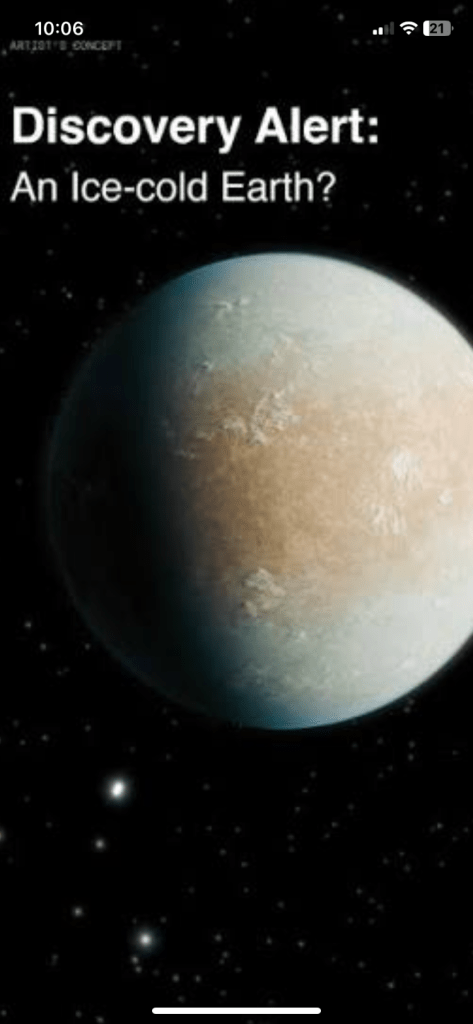
Astronomers have discovered an Earth-size planet candidate circling a nearby star on a 355-day orbit. This is a rare case where a single overlooked signal reveals a world strikingly similar to Earth in size and year.
Because the star lies only 146 light-years away and shines brightly enough for close study, the discovery immediately offers astronomers a promising target for future searches for planetary atmospheres
Key Characteristics of HD 137010 b
- Size and Orbit: The planet is estimated to be roughly 6% larger than Earth and circles a sun-like star located about 146 light-years away.
- Star Similarity: Its host star is a K-type dwarf, which is slightly cooler (about 1,000 degrees less) and less luminous than our Sun, but far more stable than the more common red dwarf stars that often blast nearby planets with radiation.
- Habitability Potential: While its proximity to its star places it at the outer edge of the habitable zone, it receives only about 33% of the heat Earth gets from the Sun. This means it could be a “cold Earth” with surface temperatures around -70°C (-94°F), similar to Mars.
- The “Refrigerated World” Theory: Astronomers are optimistic that if the planet has a dense carbon dioxide atmosphere, it could trap enough heat through a greenhouse effect to allow for liquid surface water despite the low starlight.
Current Status and Future Study
As of March 2026, HD 137010 b is still officially a planet candidate. It was discovered by re-analyzing archival data from NASA’s Kepler (K2) mission, which caught only a single 10-hour “transit” (the planet passing in front of its star)
Confirmation will require seeing additional transits, which is challenging since they only happen once a year. Future missions like the European Space Agency’s PLATO (PLAnetary Transits and Oscillations of stars), scheduled for launch in late 2026, are expected to provide the definitive data needed to confirm its orbit and begin scanning its atmosphere for biosignatures
Discovery Details
- Detection Method: The planet was found using the Transit Method by identifying a single 10-hour dip in starlight from archival NASA Kepler (K2) mission data collected in 2017.
- The Team: The discovery was led by astrophysicist Alexander Venner(University of Southern Queensland/Max Planck Institute for Astronomy) and was first flagged by citizen scientists in the Planet Hunters project.
Scientific modeling suggests
HD 137010 bhas a 51% chance of being habitable, but there is currently no evidence of life or “aliens” on the planet.
While it is nearly the same size as Earth, it is located at the extreme outer edge of its star’s habitable zone and is significantly colder. Its habitability depends almost entirely on its unknown atmosphere.
Atmospheric Greenhouse Effect: For liquid water (and potentially life) to exist, the planet would need a dense carbon dioxide-rich atmosphere to trap heat. Some researchers suggest that even if the surface is frozen, subsurface oceanscould theoretically exist.
Search for Life
There are no confirmed signs of life. However, HD 137010 b is considered a “prime target” for future search efforts:
- Proximity: At 146 light-years away, it is relatively close and orbits a bright star, making it easier to study than most other Earth-sized worlds.
- Biosignature Detection: Future observations with the James Webb Space Telescope (JWST) or the upcoming Habitable Worlds Observatory will look for “biosignatures”—gases like oxygen or methane that could indicate biological activity.
1. James Webb Space Telescope (JWST)
While the JWST is already active, HD 137010 b is expected to be a high-priority target for upcoming “cycles” of observation.
- The Goal: Use the NIRSpec and MIRIinstruments to detect Carbon Dioxide (CO2), Methane (CH4), and Water Vapor.
- Why it matters: Because the planet is so cold, detecting a massive CO2 greenhouse effect is the only way to prove it could actually host liquid water.
Extremely Large Telescope (ELT)
Currently under construction in Chile (expected first light around 2028), this ground-based giant will have a 39-meter mirror.
- The Goal: It will be powerful enough to potentially detect Molecular Oxygen in the atmospheres of nearby Earth-sized planets.
- Why it matters: Oxygen is a “smoking gun” biosignature that is much harder for space telescopes to isolate than heavier gases.
Habitable Worlds Observatory (HWO)
This is NASA’s next “Great Observatory,” specifically designed to launch in the late 2030s or early 2040s.
- The Goal: It is being built with the sole purpose of finding at least 25 Earth-like planets and searching them for signs of life.
- Why it matters: Unlike JWST, which looks at infrared (heat), the HWO will look at visible light to find “Air Force Blue” dots—direct evidence of Earth-like atmospheres.
4. PLATO (PLAnetary Transits and Oscillations of stars)
The ESA plans to launch this mission in 2026.
- The Goal: It will focus on finding and characterizing rocky planets around Sun-like stars.
- Why it matters: It will help confirm the exact mass and density of HD 137010 b, telling us for sure if it’s a rocky “Earth 2.0” or a “Mini-Neptune” made of gas.
A Cold Earth 146 Lightyears Away Could Be Habitable
Discover Magazine
Scientists discover a potentially habitable planet 146 light-years from Earth
NEWS.am TECH
James Webb Space Telescope – Wikipedia
Wikipedia
Please like subscribe comment your precious comment on universe discoveries
Full article source google
 Universe discoveries
🙏🌹
Aum Shanti
LikeLike