
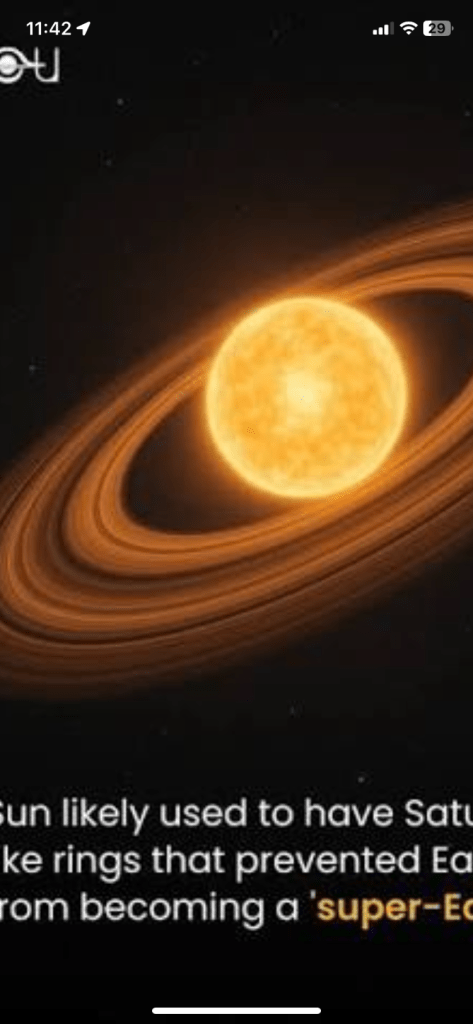
Our solar system’s rocky planets – Mercury, Venus, Earth and Mars – may have formed from two rings around the young sun, rather than a single disc
The inner solar system may have formed differently from how we have long thought it must have. For decades, researchers have thought that the rocky planets formed from a single disc of dust and debris in the early solar system, but new simulations indicate there might have been two separate discs of material.
Models featuring a single disc or ring of material around the young sun tend to be unable to recreate several features of the solar system as we observe it. For one, Earth seems to be made of two different kinds of rocks, which wouldn’t make sense if they all came from the same ring. Also, single-ring models tend to end up with Mercury and Mars too big, Venus and Earth too close together and the compositions of Earth and Mars too similar.
Recent research published in Nature Astronomy (2022) suggests that the early Sun was surrounded by three distinct rings of dust, rather than a single smooth disk. According to this model, Earth and the other rocky planets (Mercury, Venus, and Mars) formed specifically within the innermost ring
How the Rings Formed
These rings were created by “pressure bumps”—zones of high gas pressure where particles heated up and vaporized as they moved toward the Sun. These zones, known as sublimation lines, acted like cosmic “traffic jams” that trapped dust
- Inner Ring: Formed at the silicate sublimation line; eventually birthed the rocky planets (Mercury, Venus, Earth, and Mars).
- Middle Ring: Formed at the water snow line; became the gas giants (Jupiter and Saturn).
- Outer Ring: Formed at the carbon monoxide line; led to comets, asteroids, and the Kuiper Belt
Why This Matters for Earth
This “ringed” model explains several major mysteries about our solar system:
- Preventing a “Super-Earth”: The rings acted as barriers, regulating how much material moved into the inner solar system. Without these barriers, too much mass would have accumulated, likely turning Earth into a massive, scorching “super-Earth”—a type of planet common in other star systems but absent in ours.
- Mars’ Small Size: Mars formed in a low-mass region between the inner and middle rings, explaining why it is only about 10% of Earth’s mass.
- Chemical Dichotomy: The middle ring prevented material from the outer solar system from mixing with the inner system, accounting for the stark chemical differences between rocky and gas planets
Separately, other 2024–2026 research indicates that Earth itself may have once possessed its own ring system roughly 466 million years ago, likely formed from a large asteroid breaking apart
Please like subscribe comment your precious comment on universe discoveries
Full article source google


The multiple ring theory is very interesting. A super-earth would certainly not have been habitable
LikeLiked by 2 people
Yes Thomas 🎸🎸
LikeLiked by 1 person
🙏🌹
Aum Shanti
LikeLiked by 1 person
It’s very interesting very interesting. Something to think about. Wouldn’t it be something rings around earth?
LikeLiked by 1 person
Interesting read.
LikeLike