
The decades since scientists confirmed the first planet around another star have been rich in discovery, but it’s rare to see a new solar system as it forms
Planets around other stars can help answer one of the greatest mysteries: How did we get here? How did the spinning disk of material left behind by our sun’s birth form our planet and its seven neighbors? Typically astronomers find planets of similar ages to the ones in our solar system, but that’s starting to change.
In a historic first, astronomers have captured the earliest moments of planet formation around the infant star HOPS-315, offering a direct “baby picture” of what our own solar system may have looked like 4.5 billion years ago.
Using the combined power of the James Webb Space Telescope (JWST) and the Atacama Large Millimeter/submillimeter Array (ALMA), researchers identified the very first solid materials condensing from hot gas within the star’s protoplanetary disc
Key Findings of the Discovery
- The Subject: HOPS-315, a protostar approximately 1,300 light-years away in the Orion molecular cloud. It is currently about 60% of the mass of our Sun and is expected to grow into a sun-like star over the next million years.
- “Time Zero” of Formation: Unlike previous observations of fully-formed planets, this study captured the exact moment silicon monoxide (SiO) gas began cooling and crystallising into solid silicate minerals.
- Building Blocks: These tiny mineral grains are the “seeds” of planets, which will eventually clump together to form kilometre-sized planetesimals—the precursors to rocky worlds like Earth and the cores of gas giants like Jupiter.
- Familiar Location: The minerals were detected in a region of the disc equivalent to the asteroid belt in our own solar system, reinforcing models of how our cosmic home was built.
Scientific Significance
This observation, published in the journal Nature in July 2025, provides a live laboratory to test theories of planetary evolution. By seeing gas turn into rock in real-time, scientists can finally bridge the gap between theoretical models and the physical evidence found in ancient Earth meteorites.
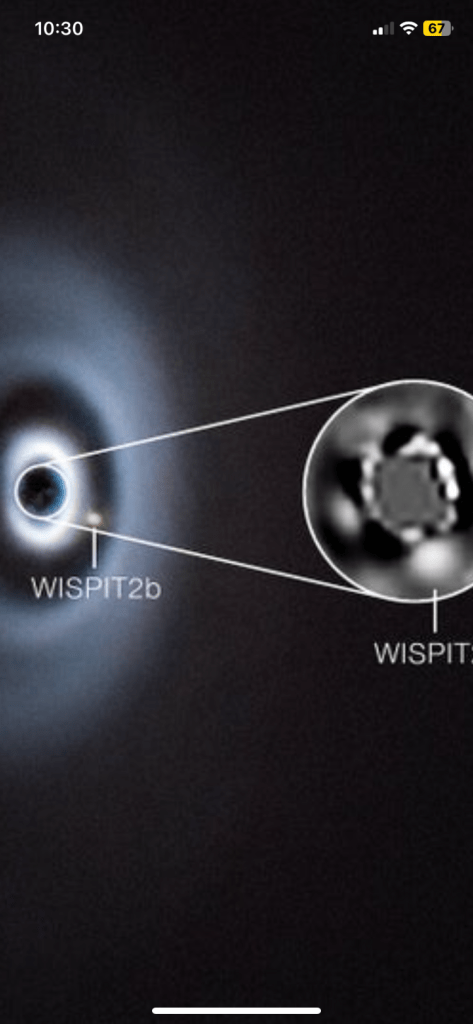
In a separate recent development from March 2026, astronomers also used the Very Large Telescope (VLT) to observe two giant gas planets actively forming around the young star WISPIT 2, further expanding our understanding of multi-planet system births.
To see through the dense “blankets” of gas and dust that surround infant stars, astronomers rely on infrared and radiowavelengths rather than the visible light our eyes can see
The discovery of HOPS-315 and WISPIT 2relied on three specific technologies:
- Near-Infrared (JWST): The James Webb Space Telescope uses gold-coated mirrors to capture heat signatures. Visible light is blocked by dust, but infrared light “sneaks” through, allowing Webb to see the glowing hot core of a star birth.
Submillimeter Waves (ALMA): Located in the high Chilean desert, ALMA doesn’t look for light at all, but for radio-like waves emitted by cold dust grains. It acts like a “zoom lens” for the debris disk, showing where the dust is clumping into planets.
- Spectroscopy: This is the real “magic.” By splitting light into a rainbow (a spectrum), telescopes can identify the unique “fingerprints” of chemicals. This is how scientists knew they were seeing silicon monoxide turning into solid rock in real-time.
Because these nurseries are so far away, these telescopes use interferometry—linking multiple dishes together to act as one giant telescope miles wide—to get the sharpest possible image.
Please like subscribe comment your precious comment on universe discoveries
Full article source google


🙏🌹
Aum Shanti
LikeLike