
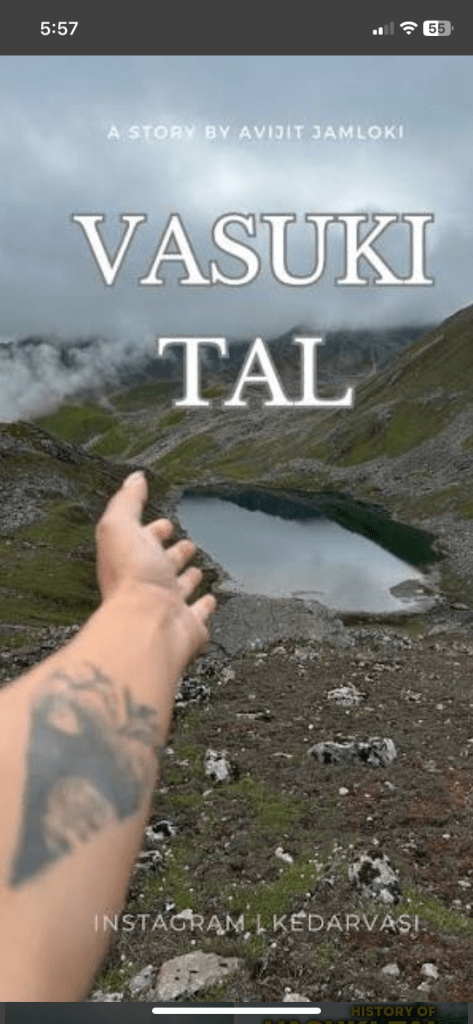
What is the story behind Vasuki Tal?
According to ancient lore, this is the very lake where Lord Vishnu is said to have bathed, imbuing it with an air of divine magic. As you stand before the shimmering surface, you’ll be treated to unparalleled vistas of the majestic Chaukhamba peaks, creating a perfect backdrop for unforgettable memories
Who is Vasuki in real story?
Vasuki is one of the sons of the sage Kashyapa and Kadru. He is accorded a significant role in the legend of Samudra Manthana. He is described to have allowed both the devas and the asuras to bind him to Mount Mandara, so that they could use him as their churning rope to extract the amrita from the Ocean of Milk.
Vasuki Tal is located approximately 8 km from the Kedarnath shrine. It is a high-altitude trek (around 4,135 meters) that takes about 4–6 hours to complete from Kedarnath. The route is a steep and narrow ascent, offering views of the Chaturangi and Vasuki glaciers.
- Distance: Approximately 8 km from Kedarnath.
- Altitude: 4,135 meters (14,200+ ft).
- Difficulty: Moderate to difficult, requiring good physical fitness.
- Trek Duration: 4–6 hours one way, depending on the pace.
- Best Time to Visit: June to October.
- Note: It is highly recommended to hire a local guide for the trek as the trail can be narrow and challenging to navigate
Trek Highlights
The trek offers breathtaking views of the surrounding Himalayan peaks, including the Chaukhamba peaks. The lake itself is known for its clear, serene waters, often surrounded by glaciers and rocky terrain
Vasuki tal is a pristine, high-altitude glacial lake situated in the Garhwal Himalayas of Uttarakhand, India. Perched at an elevation of approximately 4,135 metres (13,566 feet), it offers a serene escape for both pilgrims and adventure seekers. The lake is famous for its crystal-clear blue waters, the rare Brahma Kamal flower that blooms along its banks, and stunning views of the surrounding Chaukhamba peaks
Spiritual Significance
The lake holds deep religious importance in Hindu mythology:
- Divine Bath: It is widely believed that Lord Vishnu bathed in this lake during the auspicious festival of Raksha Bandhan.
- Mythological Naming: The lake is named after the serpent king Vasuki, who is famously depicted coiled around Lord Shiva’s neck and assisted in the churning of the cosmic ocean (Samudra Manthan
Planning Your Visit
- Best Time to Visit: The ideal windows are May to June and September to October. Avoid the monsoon (July–August) due to landslides and winter (November–April) when the region is inaccessible due to heavy snow.
- Permits: Trekkers must obtain necessary permits from the forest department before starting.
- Preparation: Prior experience with high-altitude treks is highly recommended. Hiring a professional guide is essential as parts of the glaciated trail are not well-marked
Please like subscribe comment your precious comment on universe discoveries
Full article source google
 Universe discoveries
🙏🌹
Aum Shanti
LikeLike
Your Blog beautifully weaves together mythology, geography, and spiritual depth in a way that feels both informative and quietly reverent.
What stands out most is how you bring Vasuki to life—not just as a figure from legend, but as a symbol connected to sacrifice and cosmic balance through the Samudra Manthana. That connection adds a deeper layer to Vasuki Tal, transforming it from a scenic destination into a place of living mythology.
LikeLike