
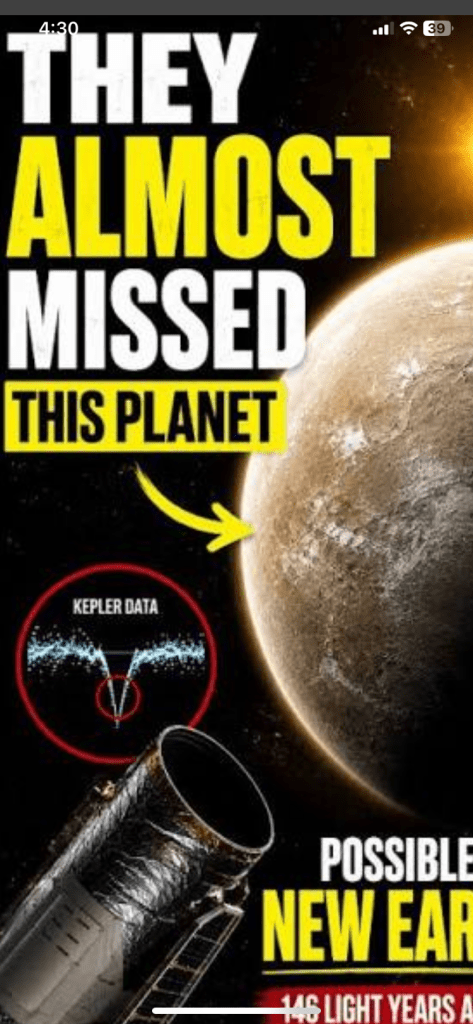
In June 2017, NASA announced the discovery of 10 new Earth-sized exoplanets that are potentially habitable. These planets were identified by the Kepler Space Telescope during its final survey of the Cygnus constellation
Key Details of the Discovery
- Habitable Zone: All 10 planets orbit their host stars in the “Goldilocks zone,” where temperatures are just right to allow liquid water to pool on the surface.
- Sun-Like Stars: Several of these worlds orbit G-type dwarf stars, which are the same type of star as our own Sun.
- Rocky Composition: Most of these planets are believed to be rocky, similar to Earth, rather than gaseous like Neptune. [1, 2, 3, 4, 5]
Top Potentially Earth-Like Candidates
While NASA’s Kepler mission has identified many candidates, here are some of the most prominent “Earth-like” worlds discovered over the years:
- KOI-7711.01 (Kepler-1606b): Often called an “Earth twin,” it is roughly 30% larger than Earth and receives nearly the same amount of energy from its star as Earth does from the Sun.
- Kepler-452b: Known as “Earth 2.0,” this was the first Earth-sized planet found in the habitable zone of a sun-like star in 2015.
- Kepler-186f: The first validated Earth-size planet found to orbit in the habitable zone of another star (a red dwarf), though it is significantly colder than Earth.
- TRAPPIST-1e: Part of a seven-planet system, this rocky world is one of the best targets for searching for liquid water and life.
- Kepler-442b: A rocky exoplanet larger than Earth but smaller than Neptune, it is considered one of the most habitable exoplanets found.
- Kepler-1649c: An Earth-sized planet orbiting a red dwarf star, receiving about 75% of the light Earth receives from the Sun.
- Proxima Centauri b: The closest known exoplanet to our solar system, located just 4.2 light-years away in the habitable zone of its star.
- Kepler-62f: A “super-Earth” about 40% larger than our planet, likely a rocky world that could have oceans.
- Kepler-22b: The first planet Kepler found in a habitable zone, though its composition—rocky, gaseous, or liquid—is still debated.
- Gliese 667Cc: A super-Earth located 22 light-years away, receiving about 90% of the light Earth does
Atmospheric “Signatures” of Life
Recent research suggests that a low carbon dioxide abundance in a planet’s atmosphere (compared to its neighbours) is a strong indicator of liquid water oceans, as oceans naturally absorb and lock away carbon. [1]
- Tidal Locking: Many of these planets (like TRAPPIST-1e) are “tidally locked,” meaning one side always faces the star. This creates extreme weather, including supersonic global hurricanes as air rushes from the scorching day side to the frozen night side.
- Volcanic Activity: Larger “Super-Earths” like Kepler-452b are likely to have high geological activity, resulting in thick, misty atmospheres filled with volcanic gases. [1, 2]
Gravity on these worlds is determined by their mass and size. Since many of these “New Earths” are Super-Earths (larger and heavier than our planet), you would feel significantly “heavier” there.
Here is how your movement and weight would change on a few of these top candidates:
1. Kepler-452b (“Earth 2.0”)
- Gravity: ~2.0g (Double Earth’s gravity).
- The Experience: If you weigh 70 kg on Earth, you would feel like you weigh 140 kg here.
- Movement: Walking would feel like carrying another person on your back. Your heart would have to work twice as hard to pump blood to your brain, and your bones and joints would face extreme stress. Long-term human survival would likely require powered exoskeletons.
2. TRAPPIST-1e
- Gravity: ~0.93g (Slightly less than Earth).
- The Experience: You would feel about 7% lighter.
- Movement: This is the closest “gravity twin” to Earth. Your movement, jump height, and gait would feel almost perfectly natural, making it one of the most comfortable destinations for human colonization.
3. Kepler-186f
- Gravity: ~1.1g to 1.3g (Estimated).
- The Experience: You would feel roughly 10–30% heavier.
- Movement: It would feel like wearing a heavy weighted vest. You would tire out faster during a hike, and your vertical jump would be noticeably shorter, but humans could likely adapt to this over time.
4. Proxima Centauri b
- Gravity: ~1.1g.
- The Experience: Very similar to Earth, just slightly “stiff.”
- Movement: You would likely barely notice the difference in a single step, though long-distance running would be more exhausting.
5. LHS 1140b
- Gravity: ~2.3g to 2.5g (One of the highest).
- The Experience: You would feel nearly 2.5 times heavier.
- Movement: Movement would be dangerous for unassisted humans. A simple trip or fall could easily result in broken bones because you would hit the ground with much greater force.
Reaching another star system is a massive undertaking because space is incredibly vast. Even the closest exoplanets would take thousands of years to reach with our current propulsion technology. [1, 2, 3, 4, 5]
Travel Time by Propulsion Speed [1]
To understand how current and theoretical speeds compare for a trip to Proxima Centauri b (4.24 light-years away):
- Voyager 1 (Current Speed): Traveling at ~61,000 km/h, it would take about 73,000 years to arrive.
- Parker Solar Probe (Fastest Man-Made Object): At its peak speed of ~690,000 km/h, the journey would still take roughly 6,700 years.
- 10% Speed of Light (Future Goal): If we could reach 30,000 km/s, the trip would drop to 42.5 years.
- Speed of Light (Theoretical Limit): The journey would take exactly 4.24 years
The Communication Gap
Even if we reached these planets, communicating with Earth would be difficult. A radio message from Proxima Centauri b would take 4.24 years just to reach Earth, meaning a simple “hello” and its reply would take over 8 years to complete.
Notable Post-2017 Discoveries
While the 2017 Kepler announcement featured 10 candidates, subsequent years have introduced even more precise “Earth twins”: [1]
- TOI-700 d & e (2020/2023): Discovered by TESS, these are Earth-sized planets in the habitable zone of a cool M-dwarf star just 100 light-years away.
- LHS 1140 b (Study Updated 2024/2026): Originally found in 2017, recent data from the James Webb Space Telescope has elevated it as a top candidate for an “ocean world” with potential habitability.
- TOI-715 b (2024): A “Super-Earth” roughly 1.5 times the size of Earth, orbiting within the conservative habitable zone of its star.
- HD 137010 b (2026): A candidate “cold Earth” roughly 6% larger than our planet, discovered by citizen scientists mining old Kepler data.
- LP 890-9 c (Speculoos-2c) (2022): The second most habitable Earth-sized planet discovered around a very cool red dwarf star. [1, 2, 3, 4, 5]
The Latest “Gold Mine” (May 2026)
In May 2026, a massive breakthrough was reported from the T16 Planet Hunt project. By using machine learning to analyze light from over 80 million stars, researchers identified 10,091 new exoplanet candidates.[1, 2, 3]
- Potential “New Earths”: Within this massive batch, astronomers estimate there are dozens to hundreds of Earth-sized planets that will require further confirmation to verify if they are rocky or habitable.
- Focus of Study: A refined catalog of 45 exoplanets has been flagged as the best current candidates for supporting life. [1, 2, 3, 4, 5]
Please like subscribe comment your precious thoughts on universe discoveries
Full article source google
 Universe discoveries
🙏🌹
Aum Shanti
LikeLiked by 1 person
Very nice.
LikeLiked by 1 person