
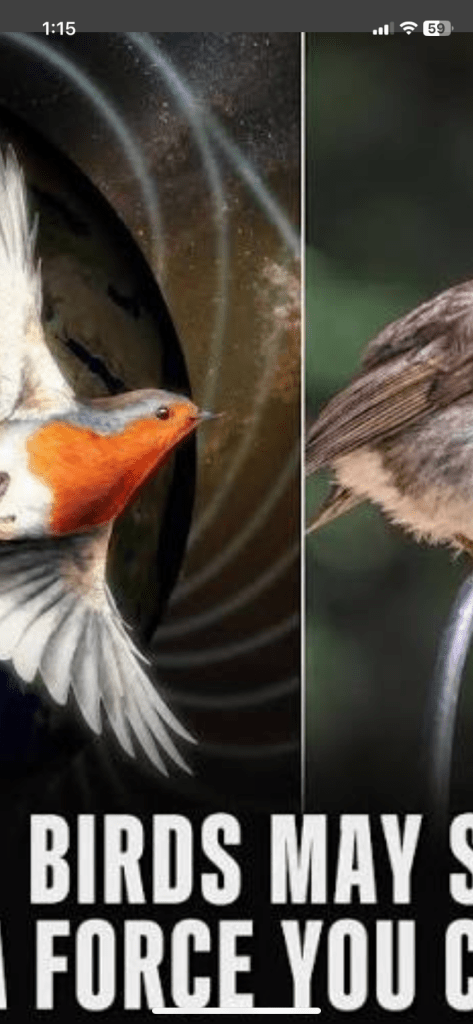
Yes, scientists have confirmed that birds can likely see the Earth’s magnetic field using a specialized light-sensitive protein in their eyes. This biological ability, called magnetoreception, essentially overlays a quantum compass onto their normal vision like a heads-up display. [1, 2, 3]
How Avian Magnetic Vision Works
- The Cryptochrome 4 (Cry4) Protein: Bird retinas contain a unique protein called Cry4. Unlike other cryptochromes that control daily sleep cycles, Cry4 levels stay constant and act purely as a magnetic tracker. [1, 2]
- Blue Light Activation: When blue light enters the bird’s eye, it strikes the Cry4 protein. This kickstarts a chemical reaction governed by quantum mechanics
Radical Pairs: The light creates a pair of highly reactive, magnetically sensitive molecules called radical pairs. The alignment of the Earth’s magnetic field directly alters how long these molecules stay active. [1, 2, 3]The Visual Overlay: The brain processes these chemical signals through its visual center. This means birds do not just “feel” the field; they likely see it as subtle shadows, bright patches, or color gradientssuperimposed on their surroundings
Secondary Backup Systems
While visual magnetoreception helps birds determine direction, they also rely on other sensory backups: [1, 2, 3]
- Beak Magnetite: Many birds have iron-rich magnetite mineral deposits in their beaks. This acts like a tiny GPS unit to measure geographic position rather than direction. [1]
- Cellular and Inner Ear Tracking: Recent studies show birds also use internal sensors, such as iron-accumulating cells in the liver and fluid-induced electrical currents in the inner ear, to maintain a flawless navigation grid. [1, 2, 3, 4]
Visual Magnetoreception in the Dark
Night-migrating birds can still see the Earth’s magnetic field because the night sky provides enough blue light to activate their specialized eye proteins. [1, 2, 3]
- Ambient Blue Light: The night sky is not completely pitch black. Even at night, scattering sunlight and moonlight fill the atmosphere with short-wavelength blue light.
- Extreme Sensitivity: The Cryptochrome 4 (Cry4) proteins in nocturnal migrants are highly sensitive. They require only a minimal amount of photons to trigger the quantum chemical reaction. [1]
- Brain Remodeling: During migration season, night-migrating birds actively remodel their brain structure. They activate a highly specialized, hyper-efficient visual processing region called “Cluster N.” [1, 2, 3]
Night Vision Boost: Cluster N is directly linked to the eye’s retinas. It drastically amplifies low-light visual signals, allowing the bird to process the magnetic visual overlay in near-darkness
Other Animals with Magnetic Superpowers
Many animals possess magnetoreception, though they do not all “see” it. They use varying biological mechanisms to map their journeys: [1, 2, 3]
1. Sea Turtles (The Global Map) [1, 2]
- Mechanism: Sea turtles use magnetite-based receptors and potentially cryptochromes to read both magnetic intensity and inclination angles. [1]
- Capability: They possess a complete bi-coordinate magnetic map. This acts exactly like a regular GPS, allowing them to determine their precise latitude and longitude in open water. [1, 2, 3, 4]
2. Whales and Dolphins (The Ocean Highways) [1]
- Mechanism: Cetaceans utilize magnetic crystals in their skulls to detect the planet’s fields.
- Capability: They navigate along topographical magnetic valleys on the ocean floor. Solar storms that disrupt the Earth’s magnetic field can confuse these animals, occasionally leading to mass beach strandings. [1, 2, 3, 4]
3. Monarch Butterflies (The Multi-Generational Compass)
- Mechanism: Monarchs rely on Cry2 proteins inside their antennae alongside a sun compass.
- Capability: This allows a butterfly that has never traveled the route before to migrate thousands of kilometers to the exact same wintering trees as its ancestors. [1, 2]
4. Salmon (The River Homeing System) [1]
- Mechanism: Salmon possess microscopic iron particles inside their sensory tissues.
- Capability: As juveniles, they imprint on the specific magnetic signature of their home river’s exit. Years later, they use this memory to find the exact same river mouth to spawn. [1, 2]
5. Honeybees (The Hive Builders)
- Mechanism: Bees contain magnetic granules in their abdomens.
- Capability: They use the grid lines to navigate toward food sources and ensure they construct new honeycomb cells in perfectly uniform directions
Full article source google
Please like subscribe comment your previous comment on universe discoveries
 Universe discoveries
Very nice.
LikeLike
🙏🌹
Aum Shanti
LikeLiked by 1 person
Yes I’ve read about this. It is fascinating. Thank you for an interesting post.
LikeLiked by 1 person
KNOWING HOW IS AS IMPORTANT AS KNOWING THAT THEY CAN!
LikeLiked by 1 person