
What if you see and experience past life regression and see your old life it would be a magical experience 💕
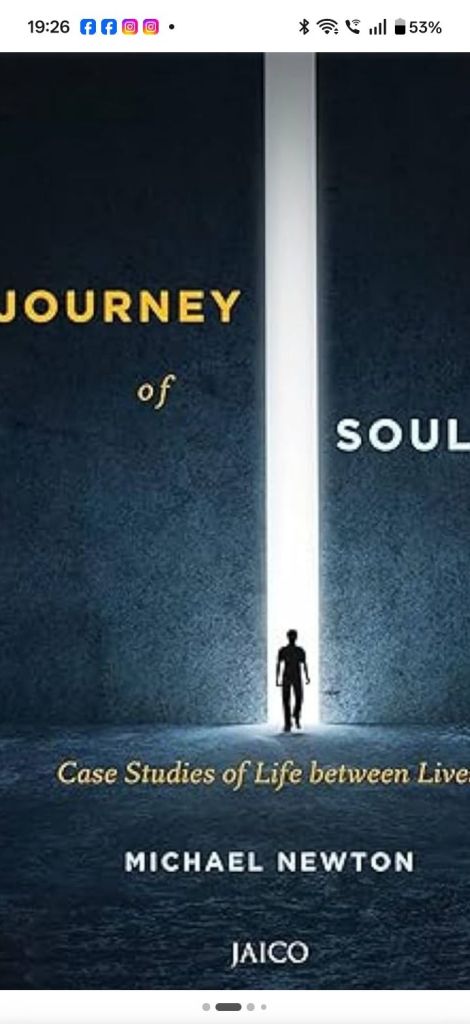
Journey of Souls: Case Studies of Life Between Lives is a bestselling spiritual book written by hypnotherapist **Dr.
Michael Newton** and published in 1994. The book details the “Life Between Lives” (LBL) state, using a specialized hypnosis technique to access the “superconscious” memories of 29 different subjects. Through these case histories, Newton maps out a structured narrative of what happens to human consciousness from the exact moment of physical death until the next reincarnation. [1, 2, 3, 4]
The Afterlife Timeline
According to the case studies documented in the book, the journey of a soul follows a highly organized, compassionate path:
- Leaving the Body: At death, the soul exits the physical body, feeling a sense of immediate freedom, light, and release from physical pain. [1, 2]
- The Welcoming: Souls are met by their personal spirit guides and soulmates to help alleviate any lingering disorientation from their human life. [1, 2]
- Homecoming and Alignment: The soul returns to its specific primary cluster or “soul group,” which consists of spirits at a similar evolutionary level. [1, 2, 3]
- The Life Review: Guided by senior spirits, the soul reviews its recent human choices as an educational documentary, experiencing the emotional impact of its actions on others to develop deeper empathy. [1]
- Soul Schools and Learning: Souls spend time studying their mistakes, learning universal laws, and preparing for future challenges in a realm of absolute consciousness. [1, 2]
- Choosing a New Body: Before reincarnating, souls preview potential new lives, choosing a specific physical body and destiny that will best facilitate their spiritual growth. [1, 2]
Key Themes Explored
- Soul Classifications: Newton outlines a spiritual hierarchy ranging from beginner souls (who require more direct management) to intermediate and highly advanced masters. [1, 2]
- Purpose of Earthly Life: Reincarnation is presented not as a punishment, but as a deliberate training ground designed for the soul’s emotional and spiritual evolution. [1, 2]
- Spirit Guides: Every individual has a personal guide who acts as an invisible mentor, structuring milestones and assisting during times of human crisis.
In near-death experiences (NDEs), God is most frequently described not as a physical, human-like figure, but as an all-encompassing, living light of infinite love and wisdom. [1, 2, 3]
While individual descriptions vary slightly based on personal and cultural backgrounds, several striking consistencies emerge from thousands of documented accounts:
Core Visual and Sensory Attributes
- Brilliant, Gentle Light: Experiencers consistently report seeing a light that is brighter than a million suns, yet it does not hurt the eyes or blind the viewer. It is often described as mesmerizing, magnetic, and completely pure. [1, 2]
- An Emanation of Emotion: The light is not just a visual element; it is a living presence. Experiencers state that the light itself is absolute, unconditional love, profound peace, and total nonjudgment. [1, 2]
- An All-Knowing Source: Many report that this divine presence serves as the “source” of all consciousness, holding infinite knowledge and ultimate authority over the universe. [1, 2]
- The “Hum” or Vibration: Some describe God less as a sight and more as an overarching, organic energy. This is sometimes accompanied by a deep, beautiful, and comforting vibration or resonance right on the edge of sound. [1]
Cultural and Religious Variations
The exact presentation of God can adapt to what the individual understands or requires for comfort:
- Religious Figures: People from specific faiths often see the divine presence take a recognizable form. For example, Christians frequently report meeting Jesus Christ, often describing him as wearing traditional robes, emanating tangible love, and looking intensely at them with eyes of profound devotion. [1, 2]
- Formless Presence: Many people, including atheists or those from non-monotheistic backgrounds, encounter a completely formless, genderless “Being of Light” or a cosmic intelligence rather than a personified figure.
- Familiarity: A massive commonality among NDErs is a sense of “homecoming.” When they encounter this deity, they feel an immediate, deeply rooted familiarity—as if they are returning to a source they have always known. [1]
Yes, near-death experiences (NDEs) frequently include detailed descriptions that individuals interpret as heaven or hell.
While the majority of reported NDEs are pleasant and peaceful, a smaller percentage are distressing or terrifying. How these experiences are described depends heavily on the individual’s personal, cultural, or religious background. Medium +1
Descriptions of “Heavenly” NDEs
The vast majority of positive NDEs share common, blissful themes: Wikipedia
- Overwhelming Love: An intense, unconditional feeling of peace, warmth, and security.
- The Bright Light: Encountering a brilliant, magnetic light that many associate with God or a divine being.
- Beautiful Landscapes: Descriptions of hyper-vivid, beautiful environments, such as radiant gardens, green pastures, and crystal-clear water.
- Reunions: Meeting deceased loved ones, angels, or spiritual guides who welcome them.
- Life Review: A panoramic playback of the person’s life, viewing their past actions through a lens of profound understanding.
Descriptions of “Hellish” NDEs
Distressing NDEs account for roughly 1% to 15% of reported cases and are typically categorized into a few types: Medium
- The Void: Experiencing a terrifying, infinite emptiness, absolute darkness, and complete isolation.
- Demonic or Threatening Entities: Encountering grotesque figures, mocking shadows, or hostile creatures.
- Classic Hellscapes: Descriptions of intense heat, fire, coldness, or hearing the screams and wails of unseeable souls.
- Valueless Void: A sense of impending doom or eternal punishment, which often motivates the individual to drastically change their life upon surviving
Near-Death Experiences (NDEs) frequently include deeply spiritual reports of meeting a loving creator, often described as a heavenly Father, while modern mainstream science does not accept the existence of a soul because it cannot be measured, tested, or observed using current scientific instruments.
Here is a breakdown of why this gap exists between spiritual experiences and scientific consensus, and how science approaches the concept of a soul.
Why NDEs Describe a “Heavenly Father”
- Universal Themes: People across cultures report overwhelming love, a bright light, and a supreme being.
- Cultural Frameworks: Experiencers often use familiar religious terms, like “Heavenly Father” or “God,” to describe an otherwise incomprehensible, formless presence.
- Profound Realism: Survivors consistently state that the experience felt “more real than real life,” permanently changing their view of death.
According to the vast majority of documented near-death experiences (NDEs), God does not actively punish souls. [1]
Instead, the concept of divine retribution or an angry deity casting souls into hell is overwhelmingly absent from mainstream NDE testimonies. Experiencers consistently report encountering a “Being of Light” or a divine presence that exudes absolute, unconditional love, total acceptance, and zero judgment. [1, 2, 3]
However, this does not mean there are no consequences for bad actions. Accountability in the afterlife is experienced differently through specific spiritual mechanisms:
1. The Life Review (Self-Judgment)
The closest thing to “punishment” in an NDE is a phenomenon known as the Life Review. [1, 2]
- The Process: Experiencers rewatch their entire lives from a panoramic, 360-degree perspective. []
- The Empathy Mechanism: You do not just watch your actions; you actually feel the exact emotional and physical impact your actions had on others. If you caused someone pain, you feel that pain intensely. If you brought someone joy, you feel that joy. [1, 2]
- The Verdict: The Being of Light does not condemn the person. Instead, the soul acts as its own judge, experiencing deep remorse and self-correction based on the stark realization of how its actions affected the interconnected web of life. [1, 2]
Please like support subscribe universe discoveries
Article courtesy google
 Universe discoveries
What a fascinating and deeply thought-provoking post! 🙏✨ The idea of exploring past lives and the journey of the soul touches one of humanity’s oldest questions—what happens to us beyond this physical life?
I found the discussion of Journey of Souls particularly intriguing. The concepts of life review, spiritual learning, soul groups, and reincarnation offer a comforting perspective: that life may be more than a series of random events, and that our experiences, relationships, mistakes, and challenges may all have a deeper purpose.
LikeLike
🙏🌹
Aum Shanti
LikeLike
Nice
LikeLike