
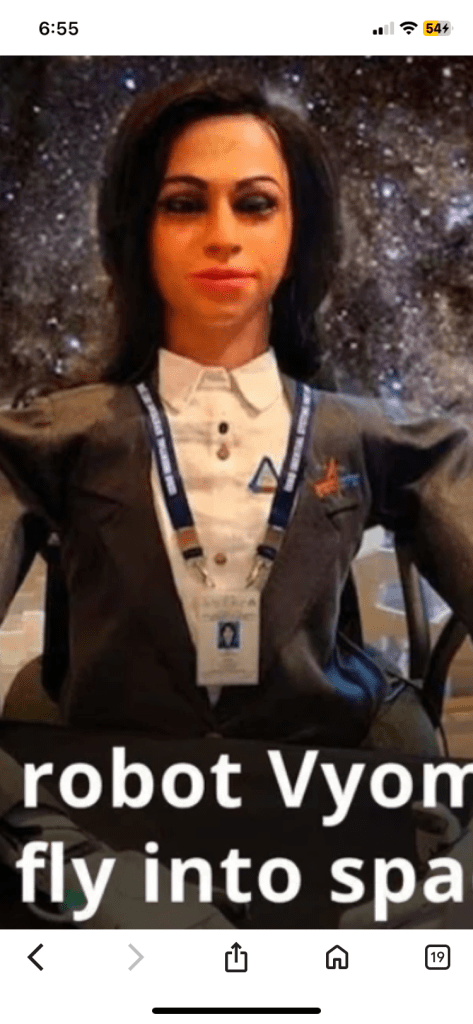
ISRO’s Vyommitra is a significant component of India’s ambitious Gaganyaan human spaceflight program. The name itself is derived from the Sanskrit words “Vyoma” (space) and “Mitra” (friend), literally meaning “friend in space.”
Vyommitra is an AI-enabled semi-humanoid robot designed to simulate a human presence in the uncrewed test flights before Indian astronauts (or ‘vyomanauts’) are sent into space. She is often referred to as a “half-humanoid” because she only has a head, torso, and arms, which is sufficient for her functions in the microgravity of space.
Here is a breakdown of her capabilities and role:
1. Talking and Communication
Vyommitra has advanced capabilities for interaction:
• Speech Recognition and Response: She can recognize and respond to human speech and commands in both English and Hindi.
• Communication with Ground Control: She is designed to communicate with the ground station, providing real-time status updates on the crew module’s environment and systems.
• Astronaut Companion: In crewed missions, she is intended to be an intelligent, anthropomorphic companion to the astronauts, potentially providing audio inputs on the health of the spacecraft.
• Facial Expressions: The robot has been designed to resemble a human and features facial expressions and speech capabilities.
2. “Thinking” and Autonomy
Vyommitra possesses a level of intelligence for autonomous operation:
• AI Module and Decision-Making: She is equipped with an AI module and decision-making algorithms that allow for limited decision-making.
• Responding to Anomalies: This autonomy enables her to mimic human responses to routine events or anomalies during the flight, which is crucial for deep-space missions where communication delays can occur.
• Executing Programmed Tasks: She can execute ISRO-programmed tasks autonomously or in coordination with mission control.
3. Working and Core Functions in Space
Vyommitra’s primary role is to act as a surrogate astronaut to validate and test the crew module systems, ensuring safety and reliability before human flight.
Vyommitra helps the ground teams study how the onboard systems perform under human-like passenger conditions, paving the way for the ultimate goal of sending Indian astronauts safely into a 400 km orbit.
ISRO’s humanoid robot Vyommitra will fly with the Gaganyaan mission to test systems and pave the way for India’s first human space mission.
What does ‘Vyommitra’ mean?
The ISRO unveiled Vyommitra in early 2020. The name is derived from Sanskrit — “Vyoma” meaning space, and “Mitra” meaning friend — literally, “friend in space”. This humanoid robot is designed to act as an intelligent, anthropomorphic companion for astronauts, handling both mechanical tasks and communication duties aboard India’s crewed spacecraft.
Vyommitra is not just a test dummy. It is a semi-humanoid robot with advanced sensors, voice recognition systems, and decision-making algorithms. Its primary mission is to simulate human functions in space and validate crew module systems before astronauts embark on their journey.
Gaganyaan will send Indian astronauts — or ‘vyomanauts’ as the ISRO calls them — into low-Earth orbit for the first time. Before that happens, ISRO plans multiple uncrewed test flights, and Vyommitra will be on board.
During these missions, Vyommitra will:
- Operate control panels and communicate with the ground station.
- Monitor environmental parameters like cabin temperature, humidity, and oxygen levels.
- Perform switch operations and system checks.
- Deliver status updates in real time.
- Imitate human physiological responses using embedded sensors.
Vyommitra’s ability to interact naturally will help ground teams study how onboard systems respond to human-like passenger conditions, ensuring the safety and reliability of future human missions.
How Vyommitra works
Vyommitra’s design strikes a balance between functionality and familiarity. Here are a few things that she can do:
- Recognise and respond to human speech and commands in English and Hindi.
- Emulate human gestures, including head and limb movements.
- Identify various control panels using vision-based technology.
- Execute ISRO-programmed tasks autonomously or in coordination with mission control.
Her AI module allows limited decision-making, mimicking cognitive responses to routine events or anomalies detected during flight. This autonomy is crucial for deep-space expeditions, where communication delays may impact real-time control.
Future prospects of Vyommitra
Last month, ISRO Chief V Narayanan said that the Vyommitra project was at an advanced stage. “This December, we plan to send the first uncrewed mission, which will include a half-humanoid called Vyommitra instead of a human being. Once this is successful, two more uncrewed missions will be completed next year.”
India will send its astronauts by the first quarter of 2027.
Vyommitra represents more than just a robot. She embodies India’s leap toward indigenous, human-rated space technology. Through her, ISRO bridges robotics, AI, and human spaceflight — a blend that showcases the agency’s multi-disciplinary strength.
Vyommitra’s technology could evolve for use in satellites, planetary rovers, or even future lunar habitats. Once fully validated, her systems could assist astronauts in complex maintenance or research tasks in microgravity environments.
Please like support subscribe comment your precious comments on universe discoveries
Full article source google
 Universe discoveries
🙏🌹
Aum Shanti
LikeLike