
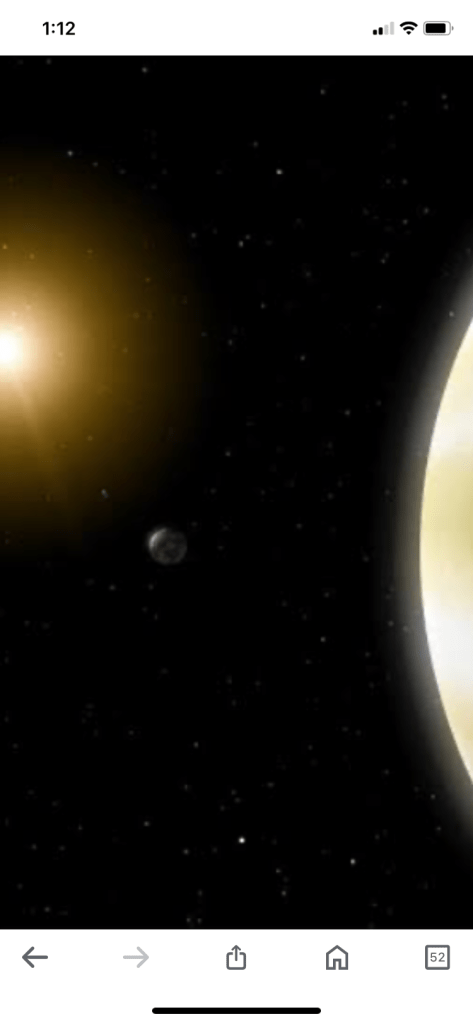
Exomoons are difficult to detect and confirm using current techniques. There have been no confirmed exomoon detections. However, there have been observations of a number of candidates, in particular around Kepler-1625b, and Kepler-1708b
In 2021, astronomers found evidence of an exomoon orbiting a Jupiter-like gas giant. The moon is huge and very different from any moon in our solar system.
Some scientists estimate that there are as many habitable exomoons as habitable exoplanets. Gas giants in the habitable zone are thought to be the best candidates to harbor Earth-like moons.
In 2021 astronomers found evidence of an exomoon orbiting the Jupiter-like gas giant. If real, it’s also an enormous moon. “The moon is pretty alien compared to any moon in the solar system,” said David Kipping, an astronomer at Columbia University involved with the discovery.
Exomoons are detected using a variety of methods, including:
- Transit method A small dip in the brightness of a star is measured. If the host planet is directly imaged, a small dip in the light received from the planet may be detected when an exomoon passes in front of it.
- Astrometry Tiny changes in the star’s position as it wobbles around its center of mass are measured.
- Direct imaging More sensitive to longer-period moons.
- Microlensing Observes what could be either a moon and a planet, or a planet and a star.
The James Webb Space Telescope (JWST) is powerful enough to detect the transit signal of exomoons.
If an exoplanet has a moon, it is also expected to leave a signature in the transit light curve. Detecting exomoons is difficult because a stellar variability component as well as photon noise are present
Exomoons are difficult to detect because they are far away and very small. They are also less likely to be detected because detection methods favor larger planets closer to their stars. These planets are less likely to have moons in stable orbits.
Other reasons why exomoons are difficult to detect include:
- Stellar variability
- Photon noise
- Difficulty separating the signal into distinct objects
- Large difference in brightness between the star and exoplanet
- Small size and irradiance of the planet
Only two of the more than 5,300 known exoplanets have been found to have moons.
Kepler-1625b I may be the first exomoon discovered. It’s a possible moon of the exoplanet Kepler-1625b. The Kepler Space Telescope first indicated its presence.
The moon is located in the Kepler 1625 system, which is about 8,000 light years away in the constellation Cygnus. It orbits the gas giant Kepler 1625b. The moon is a “gas moon,” unlike any moon in our solar system.
Astronomers believe the moon is the size of Neptune, which would make it the biggest known moon
The exomoon, Kepler 1625b I, is about the size of Neptune. It’s about twice as big as Earth’s moon in Kepler-1625b’s skies. The moon orbits 1.9 million miles from its host planet, which is about eight times farther away than Earth’s moon.
The moon and its host planet have a similar mass and radius ratio to the Earth-Moon system, but scaled up by a factor of 11. The moon is a gas moon, unlike any moon in our solar system.
Kepler-1625b is a Jovian-sized gas giant, which is 11.4 times Earth’s radius. It’s mostly made of hydrogen and helium.
The most compelling evidence for an exomoon is an exomoon transit. This is when a planet passes in front of its star, causing a momentary dimming of starlight.
Other evidence includes:
- TTV: Observed TTV
- Microlensing: Two potential exomoons that may orbit rogue planets have been detected by microlensing
- Light curve: The light curve has to be consistent with a planet on a near-circular orbit
The Hubble and Kepler space telescopes found evidence of a giant moon orbiting a gas-giant planet around the star Kepler-1625. The moon may be as big as Neptune and orbit a planet several times more massive than Jupiter
Some scientists say that exomoons are just as likely to support life as exoplanets. However, there are many factors that can affect the Earth-like nature of these celestial bodies. For example, some habitable exomoon candidates might be constantly bombarded by radiation from a powerful star, making life impossible.
Life needs liquid water and energy. However, too much energy can cause a runaway greenhouse effect, making an exomoon uninhabitable.
The first exomoons that are found are likely to be large, which makes them more likely to be habitable. Observatories coming online in the next decade may be able to characterize exomoon atmospheres and provide evidence of life.(full article source google)
Best telescopes on heavy discount on Amazon
https://130ealik57-6kr9kngv7ujukpe.hop.clickbank.net
